In the world of wireless audio, the magic that transforms digital music into sound waves reaching your ears isn’t just about Bluetooth itself. It’s profoundly influenced by the “language” your devices speak, known as audio codecs. These vital algorithms determine how audio data is compressed and transmitted, directly impacting sound quality, latency, and connection stability. Whether you’re an audiophile chasing pristine high-resolution sound or a casual listener seeking reliable everyday performance, understanding LDAC, aptX, and AAC is crucial for unlocking your Bluetooth speaker’s true potential.
Gone are the days when wireless audio meant a significant compromise in fidelity. Today’s advanced codecs promise experiences that rival, and sometimes even surpass, what was once thought possible for wireless transmission. But with a dizzying array of acronyms and specifications, choosing the right codec can feel like deciphering a secret code. This guide will demystify the leading Bluetooth audio codecs—LDAC, aptX, and AAC—breaking down their unique strengths, ideal use cases, and how they stack up against each other to help you make an an informed decision for your listening pleasure.
Demystifying Bluetooth Audio Codecs
Bluetooth audio codecs are the unsung heroes of your wireless listening experience. They are essentially digital compression and decompression tools that encode audio from your source device (like a smartphone) and decode it in your receiving device (like headphones or a speaker). Because Bluetooth has bandwidth limitations, some form of compression is always necessary. However, the efficiency and quality of this compression vary significantly between codecs, directly affecting the richness of your sound and how faithfully it reproduces the original recording.
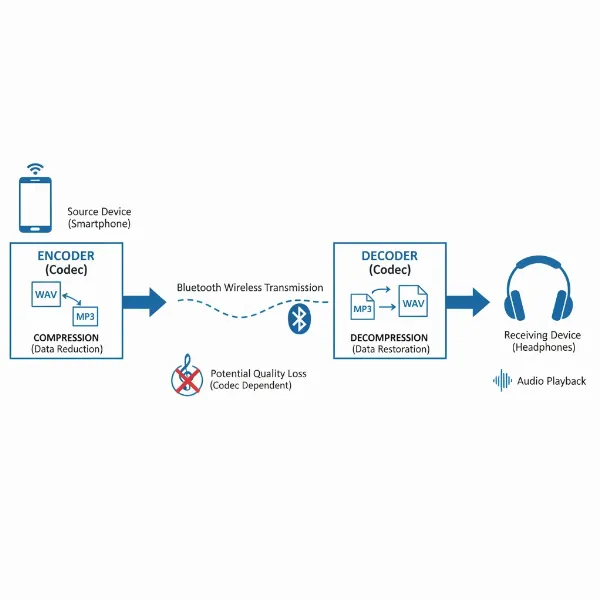 Diagram showing how Bluetooth audio codecs compress and decompress data for wireless transmission.
Understanding these differences is key to maximizing your wireless audio setup. Without a compatible codec on both ends of your connection, your devices will default to a basic, universal codec called SBC (Subband Coding), which, while widely supported, often delivers the least impressive audio quality.
LDAC: Sony’s High-Resolution Vision
What is LDAC?
LDAC is an audio coding technology developed by Sony, introduced in 2015, specifically designed to transmit high-resolution audio over Bluetooth connections. Its primary goal is to provide a near-lossless listening experience, pushing the boundaries of what wireless audio can achieve.
How it Works:
LDAC supports a variable bitrate, offering three main settings: 330 kbps, 660 kbps, and 990 kbps. At its highest setting of 990 kbps, LDAC can transmit audio at up to 24-bit/96 kHz, allowing for significantly more data transfer than most other Bluetooth codecs. This capability theoretically brings wireless audio closer to the quality of a wired connection.
Key Advantages:
- Superior Audio Quality: At its highest bitrate, LDAC delivers exceptional detail and dynamic range, making it a favorite among audiophiles for high-resolution music streaming from services like Tidal or Qobuz.
- High-Resolution Support: It’s one of the few codecs capable of handling 24-bit/96 kHz audio wirelessly.
- Android Integration: LDAC has been part of the Android Open Source Project (AOSP) since Android 8.0 Oreo, meaning many modern Android phones support it as a source.
Considerations:
- Stability: The highest 990 kbps setting can be sensitive to environmental interference and distance, potentially leading to audio dropouts or automatic down-sampling to a lower bitrate for stability.
- Default Settings: Many Android phones might default to a lower LDAC bitrate (e.g., 330 kbps or 660 kbps), requiring users to manually adjust the setting in developer options for optimal quality.
- Device Support: While widespread on Android, it’s primarily found in Sony headphones and a growing number of other compatible headphones and speakers. Apple devices do not support LDAC.
|
Our Picks for the Best Bluetooth speaker in 2026
As an Amazon Associate I earn from qualifying purchases.
|
||
| Num | Product | Action |
|---|---|---|
| 1 | Bluetooth Speaker with HD Sound, Portable Wireless, IPX5 Waterproof, Up to 20H Playtime, TWS Pairing, BT5.3, for Home/Party/Outdoor/Beach, Electronic Gadgets, Birthday Gift (Black) |

|
| 2 | Bluetooth Speaker with HD Sound, Portable Wireless, IPX5 Waterproof, Up to 20H Playtime, TWS Pairing, BT5.3, for Home/Party/Outdoor/Beach, Electronic Gadgets, Birthday Gift (Pink) |
|
| 3 | Anker Soundcore 2 Portable Bluetooth Speaker with Stereo Sound, Bluetooth 5, Bassup, IPX7 Waterproof, 24-Hour Playtime, Wireless, Speaker for Home, Outdoors, Travel |
|
| 4 | Anker Soundcore 2 Portable Bluetooth Speaker with Stereo Sound, Bluetooth 5, Bassup, IPX7 Waterproof, 24-Hour Playtime, Wireless, Speaker for Home, Outdoors, Travel |
|
| 5 | Anker Soundcore 2 Portable Bluetooth Speaker with Stereo Sound, Bluetooth 5, Bassup, IPX7 Waterproof, 24-Hour Playtime, Wireless, Speaker for Home, Outdoors, Travel- Navy Blue |
|
| 6 | Soundcore Anker 2 Portable Bluetooth Speaker with Stereo Sound, Bluetooth 5, Bassup, IPX7 Waterproof, 24-Hour Playtime, Wireless, Speaker for Home, Outdoors, Travel |
|
| 7 | Anker Soundcore 2 Portable Bluetooth Speaker with Stereo Sound, Bluetooth 5, Bassup, IPX7 Waterproof, 24-Hour Playtime, Wireless, Speaker for Home, Outdoors, Travel |
|
| 8 | Bluetooth Speaker with HD Sound, Portable Wireless, IPX5 Waterproof, Up to 20H Playtime, TWS Pairing, BT5.3, for Home/Party/Outdoor/Beach, Electronic Gadgets, Birthday Gift (Teal) |
|
| 9 | Bluetooth Speaker with HD Sound, Portable Wireless, IPX5 Waterproof, Up to 20H Playtime, TWS Pairing, BT5.3, for Home/Party/Outdoor/Beach, Electronic Gadgets, Birthday Gift (Red) |
|
| 10 | Bluetooth Speaker with HD Sound, Portable Wireless, IPX5 Waterproof, Up to 20H Playtime, TWS Pairing, BT5.3, for Home/Party/Outdoor/Beach, Electronic Gadgets, Birthday Gift (Blue) |
|
aptX: Qualcomm’s Balance of Quality and Stability
What is aptX?
aptX is a family of audio codecs developed by Qualcomm, known for striking a balance between sound quality, low latency, and connection stability. It has become a popular choice for Android users and a wide array of Bluetooth audio devices.
How it Works:
aptX uses advanced compression techniques to deliver better audio fidelity than the basic SBC codec. Over the years, Qualcomm has evolved the aptX family to cater to different user needs:
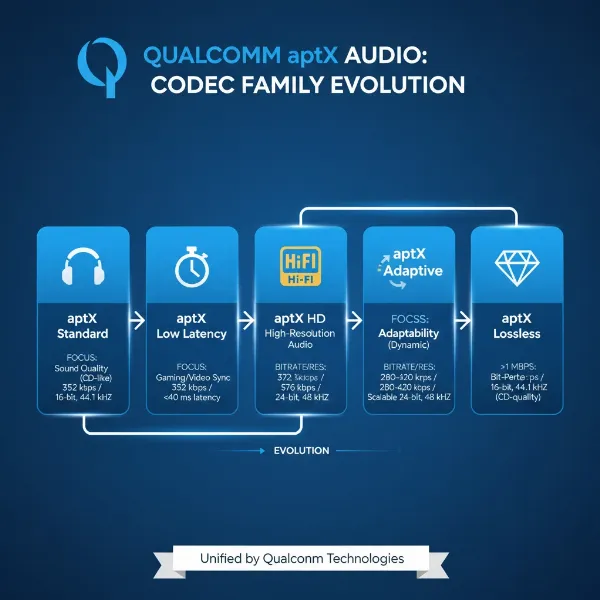 Visual representation of the Qualcomm aptX codec family, highlighting different versions and their key features.
- aptX (Standard): The original version, offering near CD-quality sound at approximately 352 kbps with 16-bit/44.1 kHz audio. It provides a noticeable improvement over SBC for everyday listening.
- aptX HD: Designed for high-resolution audio, supporting up to 24-bit/48 kHz at a bitrate of 576 kbps. It aims to deliver an audio experience that’s very close to lossless for serious music enthusiasts.
- aptX Adaptive: A versatile codec that dynamically adjusts its bitrate (between 276 kbps and 420 kbps) based on the content and environmental conditions. It intelligently prioritizes either audio quality or low latency, making it suitable for both music listening and gaming/video.
- aptX Low Latency (aptX LL): Specifically engineered for minimal audio delay (around 40ms), virtually eliminating lip-sync issues when watching videos or playing games. This often requires both the source and receiver to support aptX LL.
- aptX Lossless: A newer development aimed at delivering bit-for-bit CD-quality lossless audio (16-bit/44.1 kHz) over Bluetooth, with bitrates up to 1 Mbps.
Key Advantages:
- Enhanced Sound: Generally offers a clearer, more detailed sound profile than SBC and often performs more consistently than AAC on Android.
- Low Latency Options: aptX Adaptive and especially aptX Low Latency are excellent for multimedia consumption where synchronization is critical.
- Robust Stability: Known for maintaining a stable connection, even at higher bitrates (like aptX HD), often outperforming LDAC in challenging environments.
- Widespread Android Support: Widely adopted across Android smartphones and a vast range of compatible headphones and speakers.
Considerations:
- Not Universal: Like LDAC, aptX is not natively supported by Apple iPhones or iPads.
- Varied Versions: The different aptX versions mean you need to ensure compatibility (e.g., aptX HD source with aptX HD headphones for the best experience).
AAC: Apple’s Optimized Standard
What is AAC?
Advanced Audio Codec (AAC) is a widely used lossy compression format, familiar to anyone who uses iTunes, Apple Music, or YouTube. While not proprietary to Apple, it is the standard and most optimized Bluetooth audio codec for Apple’s ecosystem.
How it Works:
AAC delivers good sound quality at relatively low bitrates, typically up to 320 kbps (though often transmitting at 256 kbps on Apple devices). It uses advanced perceptual coding techniques to intelligently discard less audible audio information, allowing for efficient transmission without a drastic perceived loss in quality, especially on devices where it’s heavily optimized.
Key Advantages:
- Apple Optimization: AAC performs exceptionally well on Apple devices (iPhones, iPads, Macs) due providing a seamless and high-quality listening experience within the Apple ecosystem.
- Good for Streaming: Efficient for streaming services due to its balance of compression and quality.
- Low Latency (on Apple): Offers reasonably low latency for casual listening and video playback on Apple devices.
Considerations:
- Android Performance Variability: While Android devices can support AAC, its performance can be inconsistent and less efficient compared to its Apple implementation. This can sometimes lead to higher battery drain or perceived lower audio quality on Android.
- Not Hi-Res: AAC does not support true high-resolution audio formats beyond CD quality (16-bit/44.1 kHz).
- Lossy Compression: Like aptX, it is a lossy codec, meaning some audio data is permanently removed during compression.
Bluetooth Codec Comparison Table
To help you quickly grasp the differences, here’s a comparison of LDAC, aptX, and AAC:
| Feature | LDAC | aptX (Standard/HD/Adaptive) | AAC |
|---|---|---|---|
| Developer | Sony | Qualcomm | MPEG (widely adopted) |
| Max Bitrate | Up to 990 kbps (variable) | Up to 576 kbps (HD), 420 kbps (Adaptive) | Up to 320 kbps (typically 256 kbps) |
| Max Audio Quality | 24-bit/96 kHz (Hi-Res) | 24-bit/48 kHz (HD) | 16-bit/44.1 kHz |
| Key Strength | Highest potential for Hi-Res audio | Balance of quality, stability, low latency | Optimized for Apple, efficient streaming |
| Best Use Case | Audiophile listening (Android) | Android, gaming, everyday use | Apple ecosystem, streaming, general listening |
| Device Support | Android 8.0+ (source), Sony devices | Android (source), many headphones | Apple (source), many devices (sink) |
| Stability | Can be sensitive at highest bitrate | Generally robust and stable | Excellent on Apple, variable on Android |
| Latency | Medium | Low (especially aptX LL/Adaptive) | Medium |
Choosing the Right Codec for Your Needs
The “best” codec isn’t a one-size-fits-all answer; it depends entirely on your devices, listening habits, and priorities.
For the Audiophile: Chasing High Fidelity
If your priority is the absolute best possible sound quality over Bluetooth, especially with high-resolution audio files, and you use an Android phone:
- LDAC is your top choice. Pair an LDAC-compatible Android device with LDAC-enabled headphones or speakers. Be prepared to potentially delve into developer settings to ensure it’s streaming at its highest bitrate (990 kbps) and be mindful of environmental factors that could affect stability.
“For critical listening, especially with high-res tracks, LDAC at its optimal settings provides an immersive, detailed experience that truly stands out in wireless audio.” – Dr. Anya Sharma, Audio Engineering Specialist
For Android Users: Versatility and Performance
For Android smartphone users seeking a strong balance of sound quality, reliability, and low latency for various activities like gaming or video:
- aptX HD or aptX Adaptive are excellent choices. aptX HD delivers clear, high-definition sound, while aptX Adaptive offers dynamic adjustments for consistent performance and minimal lag. Ensure both your Android device and headphones support the specific aptX variant.
For Apple Users: Seamless Integration
If you’re an iPhone, iPad, or Mac user, your best bet for optimal wireless audio is clear:
- AAC. Apple devices are highly optimized to get the most out of AAC, providing reliable and high-quality audio for music, podcasts, and streaming services. While other codecs like LDAC or aptX might offer higher theoretical bitrates, they won’t be utilized by your Apple device, and AAC will deliver the most consistent and energy-efficient performance.
For Everyday Listening and Universal Compatibility
For those who prioritize universal compatibility and decent sound for casual listening without worrying about specifics:
- SBC will always be there as the fallback. However, almost any modern device will support AAC (especially with Apple products) or aptX (with Android products), offering a significant step up in quality without much effort.
Tips for Optimizing Your Wireless Audio Experience
Beyond just choosing the right codec, a few practices can help you get the most out of your Bluetooth audio setup:
- Check Device Compatibility: Always confirm that both your source device (phone, tablet, computer) and your receiving device (headphones, speaker) support the same high-quality codec you intend to use. If only one device supports it, the connection will default to the lowest common denominator, usually SBC.
- Update Firmware: Keep the firmware on your Bluetooth headphones and speakers updated. Manufacturers often release updates that can improve codec performance, stability, and add new features.
- Minimize Interference: Bluetooth operates in the 2.4 GHz band, which can be susceptible to interference from Wi-Fi routers, microwaves, and other wireless devices. Try to reduce obstacles and distance between your source and receiver for the most stable connection, especially when using high-bitrate codecs like LDAC 990 kbps.
- Source Audio Quality: Remember that the codec can only transmit what it receives. If your music files are low-quality MP3s, even the best codec won’t make them sound like high-resolution FLAC files. Use high-quality audio sources for the best results.
- Experiment with Settings (Android): On Android devices, you can often access Developer Options (by repeatedly tapping “Build Number” in “About Phone”) to manually select your preferred Bluetooth audio codec and even adjust the bitrate for LDAC or aptX Adaptive. This allows for fine-tuning based on your environment and priorities.
Conclusion
The journey into understanding Bluetooth audio codecs reveals a fascinating interplay of technology, compression, and human perception. While no wireless solution can truly replicate the uncompromised fidelity of a lossless wired connection, codecs like LDAC, aptX (including its advanced variants), and AAC have dramatically closed the gap. They empower us to enjoy high-quality audio with the convenience of wireless freedom.
Ultimately, your choice and experience with these codecs will be shaped by your specific devices and how you prioritize sound quality, latency, and connection stability. By taking a moment to understand the “language” your Bluetooth devices speak, you’re not just choosing a codec; you’re curating a superior, personalized listening experience. Which codec best suits your daily audio adventures?