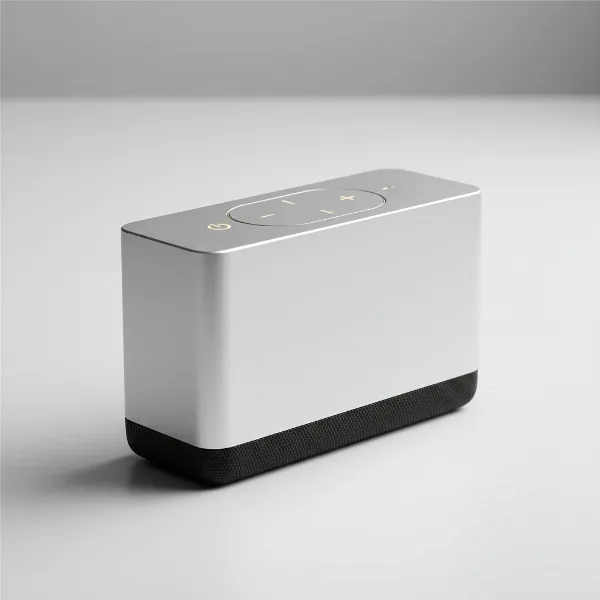
Have you ever marveled at how a compact Bluetooth speaker or a sleek soundbar can deliver such surprisingly robust bass? It’s a common paradox in the world of audio, where physics often dictates that bigger speakers equal deeper low frequencies. Yet, modern engineering has found ingenious ways around this, and a key player in this acoustic magic is the passive radiator. As someone who’s spent over a decade dissecting, evaluating, and repairing countless speaker designs, I’m here to demystify this clever component and show you how it enables small speakers to defy expectations and produce truly impactful bass. Get ready to dive into the fascinating world of portable audio, where size truly isn’t everything.
What Exactly is a Passive Radiator?
At its core, a passive radiator is a speaker component that looks very much like a conventional speaker driver, complete with a cone, surround, and spider assembly. However, here’s the crucial difference: it lacks a voice coil, magnet, and any electrical connections. In essence, it’s an unpowered cone that doesn’t receive an electrical signal directly from an amplifier. Its sole purpose is to react to the air pressure changes inside a speaker enclosure, enhancing the low-frequency output without needing its own power.
The Science Behind the Bass: How Passive Radiators Work
The magic of a passive radiator lies in its ingenious interaction with the active (powered) speaker driver and the enclosed air volume within the speaker cabinet. When the active driver moves inward and outward to produce sound, it creates fluctuations in air pressure inside the sealed enclosure. Instead of this internal air pressure being trapped or vented inefficiently, it acts upon the passive radiator’s cone, causing it to move in and out in sympathy.
This sympathetic movement is a form of resonance. The passive radiator is carefully tuned to a specific low frequency, determined by its mass (often adjustable by adding weights to the cone) and the “springiness” (compliance) of the air inside the cabinet. At or around this tuning frequency, the passive radiator takes over much of the work of moving air, effectively boosting the bass response. It behaves much like a traditional port in a bass-reflex design, but without the actual air turbulence or “chuffing” noise that can plague ports, especially in smaller systems pushed to their limits. This dynamic interplay allows the speaker system to reproduce deeper, more impactful bass frequencies than the active driver could achieve alone in the same compact space.
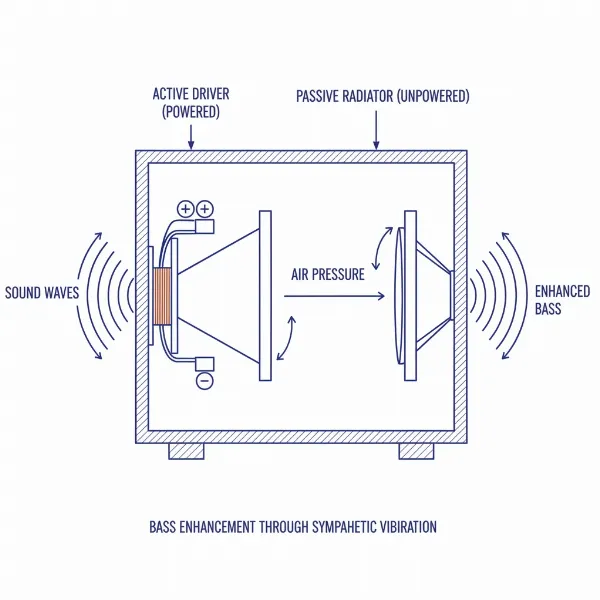 Diagram showing how a passive radiator works in a sealed speaker enclosure with an active driver.
Why Passive Radiators Are a Game-Changer for Small Speakers
The adoption of passive radiator technology has revolutionized the capabilities of compact audio devices. Their unique operational principles offer several significant advantages that directly address the challenges of achieving powerful bass from limited enclosure volumes.
Compact Size, Big Sound
|
Our Picks for the Best Bluetooth speaker in 2026
As an Amazon Associate I earn from qualifying purchases.
|
||
| Num | Product | Action |
|---|---|---|
| 1 | Bluetooth Speaker with HD Sound, Portable Wireless, IPX5 Waterproof, Up to 20H Playtime, TWS Pairing, BT5.3, for Home/Party/Outdoor/Beach, Electronic Gadgets, Birthday Gift (Pink) |

|
| 2 | Anker Soundcore 2 Portable Bluetooth Speaker with Stereo Sound, Bluetooth 5, Bassup, IPX7 Waterproof, 24-Hour Playtime, Wireless, Speaker for Home, Outdoors, Travel- Navy Blue |
|
| 3 | Anker Soundcore 2 Portable Bluetooth Speaker with Stereo Sound, Bluetooth 5, Bassup, IPX7 Waterproof, 24-Hour Playtime, Wireless, Speaker for Home, Outdoors, Travel |
|
| 4 | Soundcore Anker 2 Portable Bluetooth Speaker with Stereo Sound, Bluetooth 5, Bassup, IPX7 Waterproof, 24-Hour Playtime, Wireless, Speaker for Home, Outdoors, Travel |
|
| 5 | Anker Soundcore 2 Portable Bluetooth Speaker with Stereo Sound, Bluetooth 5, Bassup, IPX7 Waterproof, 24-Hour Playtime, Wireless, Speaker for Home, Outdoors, Travel |
|
| 6 | Bluetooth Speaker with HD Sound, Portable Wireless, IPX5 Waterproof, Up to 20H Playtime, TWS Pairing, BT5.3, for Home/Party/Outdoor/Beach, Electronic Gadgets, Birthday Gift (Teal) |
|
| 7 | Bluetooth Speaker with HD Sound, Portable Wireless, IPX5 Waterproof, Up to 20H Playtime, TWS Pairing, BT5.3, for Home/Party/Outdoor/Beach, Electronic Gadgets, Birthday Gift (Black) |
|
| 8 | Anker Soundcore 2 Portable Bluetooth Speaker with Stereo Sound, Bluetooth 5, Bassup, IPX7 Waterproof, 24-Hour Playtime, Wireless, Speaker for Home, Outdoors, Travel |
|
| 9 | Bluetooth Speaker with HD Sound, Portable Wireless, IPX5 Waterproof, Up to 20H Playtime, TWS Pairing, BT5.3, for Home/Party/Outdoor/Beach, Electronic Gadgets, Birthday Gift (Red) |
|
| 10 | Bluetooth Speaker with HD Sound, Portable Wireless, IPX5 Waterproof, Up to 20H Playtime, TWS Pairing, BT5.3, for Home/Party/Outdoor/Beach, Electronic Gadgets, Birthday Gift (Blue) |
|
One of the most compelling benefits of passive radiators is their ability to deliver extended low-frequency response from much smaller enclosures. Traditional bass-reflex (ported) designs require a port tube of a specific length and diameter to achieve a desired tuning frequency. For very low bass, these port tubes can become excessively long, making them impractical or impossible to integrate into small cabinets. Passive radiators, on the other hand, achieve similar acoustic results by vibrating a cone, eliminating the need for a bulky internal air tunnel. This design flexibility is why you often find passive radiators prominently featured in portable Bluetooth speakers, sleek soundbars, and compact subwoofers, enabling them to produce surprisingly deep and resonant bass that belies their small stature.
Eliminating Port Noise (Chuffing)
A common issue with ported speaker designs, particularly when driven hard, is “port noise” or “chuffing.” This unpleasant sound is caused by high-velocity airflow through the port, creating turbulence. Because passive radiators move a physical cone rather than relying on air rushing through an opening, they inherently eliminate this source of distortion. This results in a cleaner, quieter bass reproduction, especially at higher listening levels, allowing the pure low-frequency tones to shine through without unwanted acoustic artifacts.
Enhanced Bass Control and Clarity
Passive radiators don’t just add bass; they can also improve the quality of the bass. By resonating at specific low frequencies, the passive radiator effectively “assists” the active driver, reducing the amount of excursion (back-and-forth movement) the active driver needs to make at those frequencies. This reduction in demand on the active driver leads to less distortion and better control over the bass notes. The result is often a tighter, more articulate, and well-defined low-end, providing a satisfying “punch” without sounding boomy or muddy.
Durability and Versatility
Another practical advantage, especially for portable speakers, is that passive radiator designs maintain a sealed enclosure. Unlike ported systems where an open port allows dust, debris, and water to enter, a passive radiator seals the internal components. This makes passive radiator speakers inherently more resistant to environmental elements, a crucial factor for outdoor or bathroom-friendly Bluetooth speakers. Furthermore, their design allows for flexible placement options within a cabinet – on the front, sides, or back – which can be optimized for both acoustics and aesthetics, offering designers more creative freedom.
Passive Radiator vs. Ported vs. Sealed: A Comparison
Understanding how passive radiators stack up against other common bass-extending enclosure types can clarify their specific advantages and trade-offs. Each design approach offers a unique balance of performance characteristics, cabinet size, and cost.
| Feature | Sealed Enclosure | Ported Enclosure | Passive Radiator |
|---|---|---|---|
| Bass Depth | Good, gradual roll-off | Excellent, can reach very low | Excellent, can reach very low |
| Cabinet Size | Smallest | Generally Large | Small to Medium |
| Port Noise (Chuffing) | N/A | Can occur at high volumes | None |
| Bass Tightness/Accuracy | Excellent | Good | Very Good |
| Cost | Lowest | Moderate | Moderate to High |
| Water/Dust Resistance | Excellent | Poor (open port) | Excellent |
| Driver Excursion Control | Good | Very good around tuning freq. | Very good around tuning freq. |
Sealed Enclosures: These are the simplest designs, trapping air inside a completely sealed box. They offer extremely tight, accurate bass with a gradual roll-off, but generally have less overall bass output and don’t extend as low in frequency compared to ported or passive radiator designs of similar size. They are very forgiving of placement and amplifier power.
Ported (Bass-Reflex) Enclosures: These use a port or vent to tune the enclosure’s internal air volume, enhancing bass output around a specific frequency. They can achieve deeper and louder bass than sealed boxes but require larger cabinet volumes for proper tuning, especially for very low frequencies. They are susceptible to port noise at high volumes and offer less protection against elements due to the open port.
Passive Radiator Enclosures: As discussed, they combine aspects of both. They can achieve deep, powerful bass similar to ported designs but in more compact, sealed enclosures, eliminating port noise. While generally more expensive to implement than a simple port, they offer a compelling solution for designers seeking a blend of performance, size, and durability. However, poor design or tuning can lead to issues like increased distortion or the passive radiator “bottoming out” at extreme volumes.
Key Considerations for Passive Radiator Design
Designing a speaker system with passive radiators is more than simply adding an extra cone; it’s a careful balance of engineering to ensure optimal performance.
Matching with Active Drivers: The passive radiator must be carefully matched to the active driver(s) it supports. A common guideline suggests that the total surface area (Sd) of the passive radiator(s) should be at least twice that of the active driver. This ensures the passive radiator can move enough air without reaching its mechanical limits (excursion) too quickly, which could lead to distortion. Furthermore, the active driver’s Thiele-Small parameters, especially its Qts (total Q factor), play a crucial role. Woofers designed for ported or passive radiator enclosures typically have a lower Qts (around 0.4 or less) to integrate effectively.
The Importance of Mass and Compliance: The resonant frequency of a passive radiator system is primarily determined by the passive radiator’s moving mass and the stiffness (compliance) of the air within the enclosure. Designers often add or remove small weights from the passive radiator cone to precisely “tune” the system to the desired low-frequency extension. A heavier mass will typically lower the tuning frequency, allowing for deeper bass, while lighter mass raises it. The stiffness of the passive radiator’s suspension also contributes to its compliance and overall tuning.
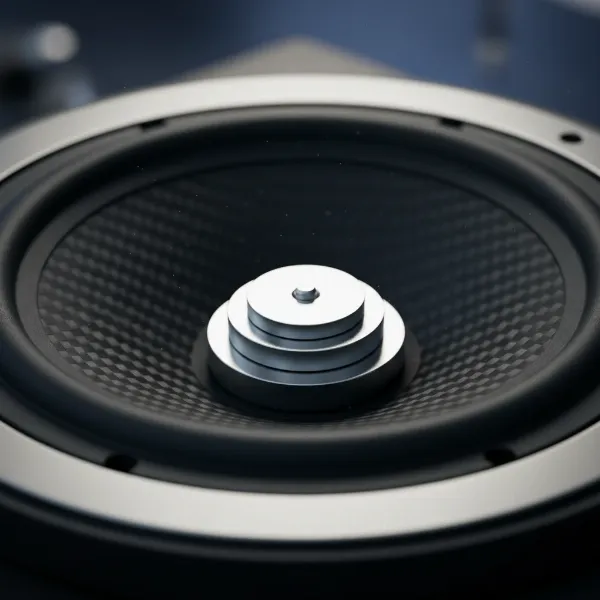 Close-up of a passive radiator cone with adjustable weights for tuning bass response.
Optimal Placement for Best Performance: While passive radiators offer flexibility, their placement within the cabinet can impact sound quality. Side or back mounting is often preferred as it minimizes interference from air counterforce and promotes better alignment with the active driver’s output, resulting in clearer, more dynamic bass. Down-firing placement, where the passive radiator faces the floor, can sometimes increase bass volume but may also lead to unclear bass due to reflections and interference, and can put undue strain on the passive radiator’s suspension over time.
Avoiding Common Pitfalls: Poorly designed passive radiator systems can exhibit several drawbacks. If the passive radiator is too small or its mass is incorrectly tuned, it can hit its excursion limits, causing an audible “thud” or distortion. Additionally, because a heavy passive radiator moves a significant amount of mass, if the speaker cabinet is not rigid and well-braced, the cabinet itself can vibrate excessively, leading to undesirable resonances and muddy sound. Achieving an ideal balance requires extensive modeling, testing, and a deep understanding of acoustic principles.
Optimizing Your Speaker’s Bass with Passive Radiators
Even with a well-designed passive radiator system, there are ways to ensure you’re getting the best possible bass performance. As an enthusiast or a casual listener, understanding these tips can elevate your audio experience.
Proper Tuning (Adjusting Mass): For custom or high-end systems, passive radiators often allow for adjustable mass. Experimenting with small weight increments can fine-tune the speaker’s bass response to your specific preferences and the acoustic characteristics of your listening space. A slight adjustment can sometimes make the difference between tight, punchy bass and a looser, less controlled sound.
Enclosure Volume and Construction: While passive radiators help compensate for small enclosures, the internal volume and rigidity of the cabinet are still critical. A robust, non-resonant enclosure prevents unwanted vibrations that can color the bass. Ensure that the cabinet is well-sealed and constructed from dense materials to maximize the effectiveness of the passive radiator.
Placement Within a Listening Environment: The room where your speaker resides plays a significant role in how you perceive bass. Placing speakers too close to walls or corners can artificially boost bass, sometimes making it boomy or indistinct due to room modes. Experiment with speaker positioning to find the sweet spot where the bass sounds balanced, clear, and impactful. For speakers with side-firing passive radiators, consider how the sound reflects off adjacent surfaces.
Role of Amplifier and Equalization: Even the most advanced passive radiator design benefits from a high-quality amplifier that can deliver clean power. Adequate power ensures the active driver can perform optimally, thus properly exciting the passive radiator. Furthermore, judicious use of equalization (EQ) can tailor the bass response to your liking or compensate for room acoustics. A subtle bass boost at very low frequencies can enhance the depth, while reducing exaggerated mid-bass can improve clarity. However, be cautious not to over-EQ, as this can introduce distortion or push the drivers beyond their limits.
Conclusion
Passive radiators stand as a testament to innovative acoustic engineering, offering a brilliant solution for achieving deep, resonant bass in increasingly compact speaker designs. By harnessing the internal air pressure generated by the active driver, these unpowered cones extend the low-frequency response, reduce distortion, and eliminate the noisy turbulence often associated with traditional ported enclosures. From the portable Bluetooth speakers we carry to sophisticated home audio systems, passive radiators are vital in shaping the soundscape of modern audio. They prove that impressive bass isn’t solely about brute force, but often about clever design and harnessing the subtle physics of sound. So, the next time you hear rich, full bass emanating from a surprisingly small speaker, remember the silent workhorse within. What further innovations do you think will redefine speaker performance in the future?
Frequently Asked Questions
Do passive radiators need power?
No, passive radiators are entirely unpowered. They do not have a voice coil or magnet assembly and receive no direct electrical input from an amplifier. Instead, their movement is driven solely by the changes in air pressure created by the active (powered) speaker driver within the sealed enclosure.
Can a passive radiator improve any speaker?
While passive radiators can significantly enhance bass response, they are not a universal solution for every speaker. They must be carefully designed and tuned in conjunction with the specific active driver and enclosure volume. Attempting to add a passive radiator to an existing speaker not designed for one can lead to unbalanced sound or poor performance.
How do I know if my speaker has a passive radiator?
You can usually identify a passive radiator by its appearance. It looks like a speaker cone, complete with a surround, but you won’t see a central dust cap or hear sound directly from it (though you may feel it vibrate). Many portable Bluetooth Speakers feature visible passive radiators, often on the sides or back, which you can see moving when bass-heavy music plays.
What is the ideal ratio of passive radiator size to active driver size?
A general rule of thumb in speaker design is that the total effective surface area (Sd) of the passive radiator(s) should be at least twice that of the active driver. This larger surface area helps ensure the passive radiator can move enough air without exceeding its mechanical excursion limits, contributing to cleaner and more efficient bass output.
Are passive radiators better for music or movies?
Passive radiators are excellent for both music and movies, particularly when deep, impactful bass is desired from a compact system. For music, they provide extended low-frequency response for a full sound profile. For movies, they enhance the realism of explosions and low-rumble effects, immersing you further into the cinematic experience, all without the distortion sometimes found in ported designs.
Can passive radiators produce distortion?
Yes, passive radiators can produce distortion if not properly designed or if the speaker system is overdriven. Issues can arise if the passive radiator is too small for the enclosure or active driver, leading to it reaching its excursion limits and “bottoming out.” Incorrect tuning (mass loading) or a poorly braced cabinet can also introduce unwanted resonances or vibrations, which manifest as distortion.