Choosing the right Bluetooth speaker can elevate your audio experience, whether you’re a music enthusiast or someone who enjoys podcasts on the go. One of the most fundamental decisions you’ll face is understanding the difference between mono and stereo Bluetooth speakers. While both deliver sound wirelessly, their approach to audio reproduction creates distinct listening experiences. As a seasoned technician with over a decade in the Bluetooth speaker realm, I’m here to guide you through this key distinction, helping you pinpoint the ideal speaker for your lifestyle and preferences.
Understanding Audio Basics: Mono vs. Stereo
Before diving into specific speaker types, it’s essential to grasp the core concepts of mono and stereo sound. This understanding will empower you to make an informed decision tailored to your listening habits.
What is Mono Sound?
|
Our Picks for the Best Bluetooth speaker in 2026
As an Amazon Associate I earn from qualifying purchases.
|
||
| Num | Product | Action |
|---|---|---|
| 1 | Bluetooth Speaker with HD Sound, Portable Wireless, IPX5 Waterproof, Up to 20H Playtime, TWS Pairing, BT5.3, for Home/Party/Outdoor/Beach, Electronic Gadgets, Birthday Gift (Pink) |

|
| 2 | Anker Soundcore 2 Portable Bluetooth Speaker with Stereo Sound, Bluetooth 5, Bassup, IPX7 Waterproof, 24-Hour Playtime, Wireless, Speaker for Home, Outdoors, Travel |
|
| 3 | Soundcore Anker 2 Portable Bluetooth Speaker with Stereo Sound, Bluetooth 5, Bassup, IPX7 Waterproof, 24-Hour Playtime, Wireless, Speaker for Home, Outdoors, Travel |
|
| 4 | Anker Soundcore 2 Portable Bluetooth Speaker with Stereo Sound, Bluetooth 5, Bassup, IPX7 Waterproof, 24-Hour Playtime, Wireless, Speaker for Home, Outdoors, Travel |
|
| 5 | Anker Soundcore 2 Portable Bluetooth Speaker with Stereo Sound, Bluetooth 5, Bassup, IPX7 Waterproof, 24-Hour Playtime, Wireless, Speaker for Home, Outdoors, Travel- Navy Blue |
|
| 6 | Bluetooth Speaker with HD Sound, Portable Wireless, IPX5 Waterproof, Up to 20H Playtime, TWS Pairing, BT5.3, for Home/Party/Outdoor/Beach, Electronic Gadgets, Birthday Gift (Black) |
|
| 7 | Anker Soundcore 2 Portable Bluetooth Speaker with Stereo Sound, Bluetooth 5, Bassup, IPX7 Waterproof, 24-Hour Playtime, Wireless, Speaker for Home, Outdoors, Travel |
|
| 8 | Bluetooth Speaker with HD Sound, Portable Wireless, IPX5 Waterproof, Up to 20H Playtime, TWS Pairing, BT5.3, for Home/Party/Outdoor/Beach, Electronic Gadgets, Birthday Gift (Blue) |
|
| 9 | Bluetooth Speaker with HD Sound, Portable Wireless, IPX5 Waterproof, Up to 20H Playtime, TWS Pairing, BT5.3, for Home/Party/Outdoor/Beach, Electronic Gadgets, Birthday Gift (Teal) |
|
| 10 | Bluetooth Speaker with HD Sound, Portable Wireless, IPX5 Waterproof, Up to 20H Playtime, TWS Pairing, BT5.3, for Home/Party/Outdoor/Beach, Electronic Gadgets, Birthday Gift (Red) |
|
Mono, short for monophonic, refers to audio that uses a single channel. All sounds are combined into one signal and reproduced through one or more speakers as a unified output. Imagine a single point from which all sound emanates; regardless of how many individual drivers a speaker has, if it’s playing in mono, every driver receives and outputs the exact same audio signal. This results in a focused and consistent sound profile.
What is Stereo Sound?
Stereo, or stereophonic sound, utilizes two independent audio channels: a left channel and a right channel. These separate signals are delivered to distinct speakers or drivers, creating a sense of width, depth, and direction in the audio landscape. When mixed correctly, stereo sound can make instruments and vocals appear to come from different points in space, providing a more immersive and realistic listening experience. This is often achieved through True Wireless Stereo (TWS) technology, where two separate mono-capable Bluetooth speakers are paired wirelessly to act as dedicated left and right channels, or through a single enclosure designed with physically separated left and right drivers.
Key Differences at a Glance
To quickly compare the two, here’s a breakdown of their primary characteristics:
| Feature | Mono Speakers | Stereo Speakers (or TWS setup) |
|---|---|---|
| Audio Channels | 1 (single, combined signal) | 2 (distinct Left & Right channels) |
| Soundstage | Focused, centralized | Wide, expansive, immersive |
| Directionality | Consistent from all angles | Positional audio, requires a “sweet spot” |
| Best For | Voice, background music, portability | Music, movies, gaming, critical listening |
| Cost (Generally) | Lower | Higher (especially for TWS pairs) |
| Portability | High | Moderate (single unit), Lower (TWS pair) |
| Battery Life | Often better | Good (single unit), potentially shorter (TWS pair) |
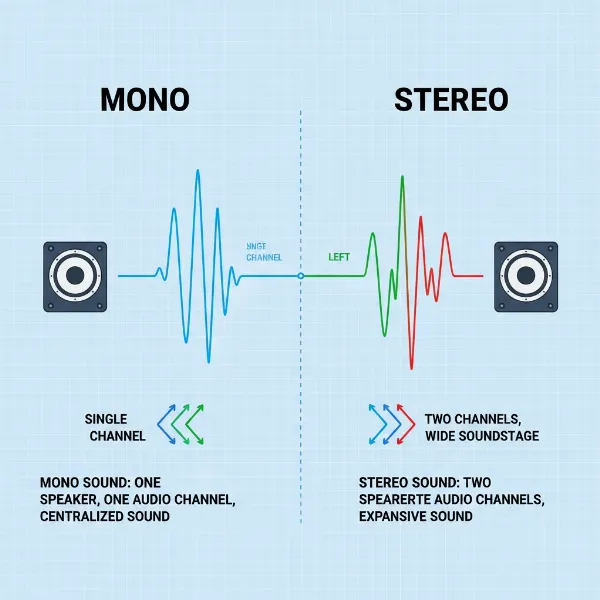 Diagram comparing mono and stereo sound waves and speaker setups
Mono Bluetooth Speakers: Simplicity and Consistency
Mono Bluetooth speakers are often the unsung heroes of portable audio, prized for their straightforward functionality and robust performance in specific scenarios.
Advantages of Mono Bluetooth Speakers
Mono speakers offer several compelling benefits. First and foremost, they typically boast superior portability due to their compact size and simpler internal components. Many rugged, adventure-ready Bluetooth speakers are mono, designed to withstand the elements without compromising on sound projection. Their sound output is also remarkably consistent from all angles. This omnidirectional quality means that everyone in a group hears the same balanced audio, regardless of their position relative to the speaker. This consistency makes them ideal for outdoor gatherings or environments where listeners are moving around.
Furthermore, mono speakers are often more energy-efficient, translating to longer battery life on a single charge. Their simpler design often makes them less expensive to purchase, offering excellent value for basic audio needs. For content like podcasts, audiobooks, or phone calls, where vocal clarity is paramount, mono speakers deliver focused and precise sound without spatial distractions. They also avoid potential syncing issues that can sometimes arise with complex stereo setups.
Disadvantages of Mono Bluetooth Speakers
While practical, mono speakers do have limitations. The most notable drawback is their lack of immersive depth for music. Because all audio is compressed into a single channel, the rich soundscapes and instrument separation present in stereo recordings are lost. This can make music feel “flat” or less engaging compared to a true stereo experience. If you’re a connoisseur of intricate musical arrangements, you might find mono sound less satisfying.
Ideal Use Cases for Mono Speakers
Mono Bluetooth speakers truly shine in specific applications:
- Outdoor Adventures: Their robust, often waterproof designs and consistent sound dispersion make them perfect for beach trips, hiking, or poolside listening.
- Podcasts & Audiobooks: For spoken-word content, clear vocal reproduction is key, which mono speakers deliver exceptionally well.
- Background Music: In social settings or for casual listening where the primary focus isn’t on critical audio analysis, mono speakers provide unobtrusive background tunes.
- Small Spaces & Personal Use: When space is limited, or for individual listening where maximum immersion isn’t the goal, a compact mono speaker is highly practical.
- Phone Calls & Conferencing: For clear voice communication, a mono speaker simplifies the audio, making conversations easier to follow.
Many portable speakers feature a single, powerful driver designed for mono playback. Examples often include very compact cylindrical or cube-shaped models.
Stereo Bluetooth Speakers: Immersion and Depth
For those who prioritize a rich, detailed, and enveloping audio experience, stereo Bluetooth speakers are the preferred choice. They aim to replicate the natural way we hear sound in the world.
Advantages of Stereo Bluetooth Speakers
The primary advantage of stereo speakers lies in their ability to create an immersive and realistic soundstage. By separating audio into left and right channels, they can reproduce the spatial cues found in recordings, making it feel like instruments and vocals are positioned in distinct locations. This spatial depth and width significantly enhance the enjoyment of music, movies, and gaming, pulling you deeper into the content. Stereo sound can reveal subtle details in a mix that might be lost in mono, offering a fuller and more dynamic audio spectrum from deep bass to crisp treble. This creates what’s often referred to as a “phantom center,” where sounds appearing equally from both channels seem to originate from the middle.
Disadvantages of Stereo Bluetooth Speakers
True stereo sound often comes with certain caveats. Achieving the optimal stereo effect requires a “sweet spot”—a listening position equidistant from both left and right channels. Moving outside this zone can diminish the perceived separation and immersion. Many compact Bluetooth speakers advertised as “stereo” might have two drivers, but their close proximity means the stereo separation is minimal, essentially sounding like mono. To experience true stereo from a single portable unit, you generally need a larger speaker with more widely spaced drivers, which can impact portability and cost. For a truly convincing stereo sound from portable Bluetooth speakers, a True Wireless Stereo (TWS) setup is often recommended, which involves pairing two separate speakers.
True Wireless Stereo (TWS): The Solution for True Stereo Portability
True Wireless Stereo (TWS) technology has revolutionized portable audio by allowing two individual Bluetooth speakers to connect wirelessly to each other and function as a dedicated left and right stereo pair. This means you can achieve genuine stereo separation without any connecting wires between the speakers themselves.
- How TWS Works: In a TWS setup, one speaker acts as the primary unit, receiving the Bluetooth audio signal from your device. It then wirelessly transmits the right (or left) channel to the secondary speaker, creating a synchronized stereo output.
- Benefits of TWS: This system offers the best of both worlds: the portability of individual units combined with the immersive soundstage of stereo. You have the flexibility to place the speakers to optimize your listening experience, expanding the sound beyond the confines of a single speaker enclosure.
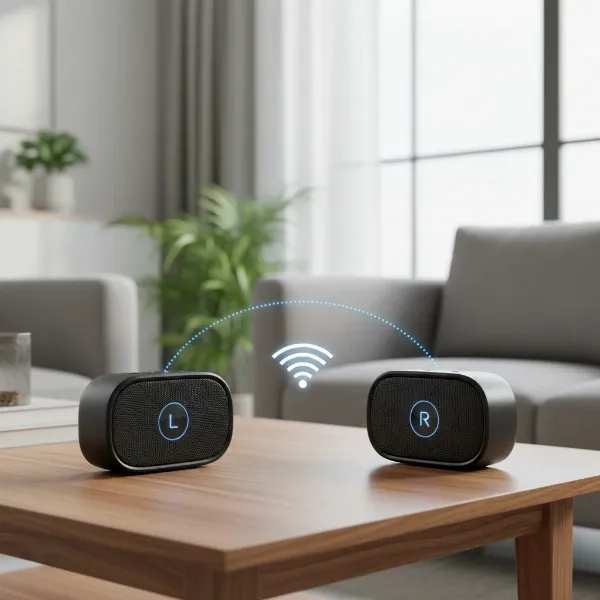 Two portable Bluetooth speakers wirelessly connected in a TWS setup
Ideal Use Cases for Stereo Speakers
Stereo Bluetooth speakers, especially with TWS, are best suited for:
- Critical Music Listening: For audiophiles and music lovers who appreciate the intricate layers and spatial nuances of their favorite tracks.
- Home Entertainment: Enhancing the audio for movies, TV shows, and gaming, providing a more cinematic or engaging experience.
- Creating a Soundstage: When you want to fill a room with rich, directional sound, placing two TWS speakers strategically can transform the ambiance.
- Immersive Personal Listening: When you can position yourself in the sweet spot for a deeply engaging individual session.
Choosing Your Ideal Bluetooth Speaker: A Buying Guide
Selecting between mono and stereo isn’t about one being inherently “better” but rather about finding the right fit for your specific needs. Here’s what to consider:
Determine Your Primary Use
- Music Enthusiast (Critical Listening): If your main goal is to fully appreciate the detail and soundstage of music, especially genres with complex arrangements, a stereo setup (preferably TWS) is likely your best bet.
- Podcasts & Audiobooks: For primarily spoken-word content, the enhanced clarity and portability of a mono speaker might be more advantageous.
- Outdoor Adventures/Parties: A rugged mono speaker with consistent 360-degree sound is often ideal, as listeners will be spread out and moving. If you want more power and can manage two speakers, a TWS pair offers more impact.
- Home Entertainment: Stereo speakers, particularly those with good driver separation or TWS capabilities, will provide a more cinematic experience.
Consider Your Listening Environment
- Small Rooms/Personal Desks: A high-quality mono speaker might suffice, or a compact stereo speaker where the drivers are close together. The stereo effect will be subtle but still present.
- Large Rooms/Open Spaces: Stereo speakers (especially TWS pairs placed some distance apart) are better at filling larger areas and creating a more encompassing sound.
- Dynamic Environments (e.g., Beach, Park): Mono speakers offer consistent sound regardless of listener position.
Budget Considerations
Generally, mono Bluetooth speakers are more affordable. If you opt for a true stereo experience with a TWS setup, you’ll be purchasing two speakers, which will naturally increase the overall cost. Determine what you’re willing to invest in your audio quality.
Portability Needs
If maximum portability, lightness, and durability are paramount, a compact mono speaker is often the way to go. If you don’t mind a slightly larger device or carrying two units, a stereo or TWS option becomes viable.
Sound Quality Expectations
Are you looking for background ambience or a concert-like experience? For casual listening, mono speakers deliver perfectly acceptable quality. For a nuanced, layered sound, stereo is superior. Modern Bluetooth codecs have significantly improved the fidelity of wireless audio, making high-quality sound achievable with both types.
Connectivity & Features
- Bluetooth Version: Look for Bluetooth 5.0 or newer for improved range, stability, and energy efficiency.
- Codecs: While many users won’t notice a drastic difference, codecs like aptX or LDAC can offer higher fidelity audio for compatible devices.
- Multi-Speaker Pairing: If you’re considering TWS, ensure the speakers explicitly support this feature. Some brands offer “Party Mode,” which plays the same mono audio across multiple speakers, distinct from true stereo pairing.
Maximizing Your Bluetooth Speaker Experience
Regardless of whether you choose mono or stereo, a few tips can help you get the most out of your speaker.
How to Connect Your Bluetooth Speaker with Devices
Connecting is usually straightforward:
- Power On: Turn on your Bluetooth speaker.
- Pairing Mode: Activate the speaker’s pairing mode (often a dedicated button or holding the power button). The indicator light will usually blink.
- Device Settings: On your smartphone, tablet, or computer, go to Bluetooth settings and ensure Bluetooth is enabled.
- Select Speaker: Find your speaker in the list of available devices and tap to connect.
- TWS Pairing (if applicable): For TWS, follow your speaker’s specific instructions to link the two speakers together before connecting them to your device.
How to Optimize Sound Quality
- Placement: For stereo speakers, experiment with placement. A classic setup involves forming an equilateral triangle between the two speakers and your listening position. For mono speakers, central placement often works best for even sound dispersion.
- Source Quality: High-quality audio files (e.g., lossless formats or high-bitrate streams) will always sound better, regardless of your speaker type.
- Volume Levels: Pushing any speaker to its maximum volume can introduce distortion. Find a comfortable listening level below the absolute max.
How to Clean and Maintain Your Bluetooth Speaker
- Regular Cleaning: Use a soft, dry, lint-free cloth to wipe down the exterior. For grilles, a soft brush can remove dust.
- Water Resistance: If your speaker is water-resistant (e.g., IPX7 rated), feel free to rinse it under a tap or wipe it with a damp cloth after outdoor use. Always ensure port covers are sealed.
- Battery Care: Avoid fully discharging the battery repeatedly. Charge it regularly and store it with some charge if not using it for extended periods.
- Avoid Extremes: Protect your speaker from extreme temperatures and direct prolonged sunlight.
Conclusion
The debate between mono and stereo Bluetooth speakers ultimately boils down to your individual needs and listening preferences. Mono speakers excel in portability, durability, and delivering consistent, clear audio, making them perfect for voice-centric content and dynamic environments. Stereo speakers, especially those leveraging True Wireless Stereo technology, offer a richer, more immersive soundstage, ideal for music, movies, and gaming where spatial depth is desired.
As you embark on your journey to find the perfect Bluetooth speaker, consider where and how you’ll primarily use it. Are you prioritizing compact convenience and consistent background audio, or a captivating, detailed sound experience that puts you right in the heart of the music? The good news is that advancements in Bluetooth technology offer fantastic options in both categories, ensuring there’s a speaker out there that perfectly aligns with your audio aspirations. Which type of Bluetooth speaker will truly enhance your sound adventure?
Frequently Asked Questions
Can a mono Bluetooth speaker provide a good listening experience?
Absolutely. A good mono Bluetooth speaker can deliver crisp, clear audio, especially for podcasts, audiobooks, and casual music listening. Their strength lies in consistent sound projection from any angle, making them highly effective for outdoor use or group settings where immersive stereo isn’t the primary goal.
Do all portable Bluetooth speakers offer true stereo sound?
No, not all portable Bluetooth speakers offer true stereo sound. Many compact speakers with two drivers are marketed as “stereo” but their drivers are so close together that the stereo separation is minimal, effectively sounding like mono. For genuine stereo from portable units, you typically need either a larger speaker with widely spaced drivers or two separate speakers paired using True Wireless Stereo (TWS) technology.
What is True Wireless Stereo (TWS) and how does it relate to stereo Bluetooth speakers?
True Wireless Stereo (TWS) is a feature that allows two independent Bluetooth speakers to connect wirelessly to each other to create a genuine left and right stereo pair. This setup provides a much more immersive and spacious sound experience than a single speaker, letting you place the speakers for optimal stereo separation.
Is stereo worth the extra cost for a portable Bluetooth speaker?
Whether stereo is worth the extra cost depends on your priorities. If you primarily listen to music or movies and crave a rich, immersive soundstage with distinct instrument separation, then investing in a stereo-capable speaker or a TWS pair is likely worthwhile. For background music, podcasts, or maximum portability, a more affordable mono speaker might be perfectly adequate.
Which is better for outdoor use, a mono or stereo Bluetooth speaker?
For most outdoor scenarios, a mono Bluetooth Speaker is often better. Its consistent, omnidirectional sound ensures that everyone hears the audio clearly, regardless of their position relative to the speaker. Mono speakers also tend to be more rugged, compact, and have better battery life, which are key advantages for outdoor adventures.