Is your trusty Bluetooth speaker struggling to hold a charge, cutting out mid-song, or refusing to power on entirely? Don’t let a failing battery silence your favorite tunes or force you to spend money on a new device. Many “old” Bluetooth speakers still boast excellent sound quality, and often, a simple battery replacement is all it takes to bring them back to life. With a few common tools and a bit of patience, you can extend the lifespan of your beloved portable audio companion and keep the music playing without interruption.
Common Types of Bluetooth Speaker Batteries
Understanding the type of battery in your Bluetooth speaker is the first step toward a successful replacement. While the process of opening the speaker is generally similar, the actual battery connection and handling might vary based on its chemistry and form factor.
Lithium-Ion (Li-ion) Batteries
- Pros: High energy density, lightweight, rechargeable, widely used in modern portable electronics. They offer good power-to-weight ratio and a relatively slow self-discharge rate.
- Cons: Can be sensitive to overcharging/discharging, potential for thermal runaway if damaged, and may require soldering for replacement in some speakers.
- Key Features to Consider: These often come in various shapes and sizes, including cylindrical (like 18650 cells) or flat pouch cells. They usually have two wires (red for positive, black for negative) connecting to the speaker’s circuit board.
|
Our Picks for the Best Bluetooth speaker in 2026
As an Amazon Associate I earn from qualifying purchases.
|
||
| Num | Product | Action |
|---|---|---|
| 1 | Anker Soundcore 2 Portable Bluetooth Speaker with Stereo Sound, Bluetooth 5, Bassup, IPX7 Waterproof, 24-Hour Playtime, Wireless, Speaker for Home, Outdoors, Travel- Navy Blue |

|
| 2 | Bluetooth Speaker with HD Sound, Portable Wireless, IPX5 Waterproof, Up to 20H Playtime, TWS Pairing, BT5.3, for Home/Party/Outdoor/Beach, Electronic Gadgets, Birthday Gift (Black) |
|
| 3 | Anker Soundcore 2 Portable Bluetooth Speaker with Stereo Sound, Bluetooth 5, Bassup, IPX7 Waterproof, 24-Hour Playtime, Wireless, Speaker for Home, Outdoors, Travel |
|
| 4 | Anker Soundcore 2 Portable Bluetooth Speaker with Stereo Sound, Bluetooth 5, Bassup, IPX7 Waterproof, 24-Hour Playtime, Wireless, Speaker for Home, Outdoors, Travel |
|
| 5 | Bluetooth Speaker with HD Sound, Portable Wireless, IPX5 Waterproof, Up to 20H Playtime, TWS Pairing, BT5.3, for Home/Party/Outdoor/Beach, Electronic Gadgets, Birthday Gift (Pink) |
|
| 6 | Bluetooth Speaker with HD Sound, Portable Wireless, IPX5 Waterproof, Up to 20H Playtime, TWS Pairing, BT5.3, for Home/Party/Outdoor/Beach, Electronic Gadgets, Birthday Gift (Teal) |
|
| 7 | Anker Soundcore 2 Portable Bluetooth Speaker with Stereo Sound, Bluetooth 5, Bassup, IPX7 Waterproof, 24-Hour Playtime, Wireless, Speaker for Home, Outdoors, Travel |
|
| 8 | Bluetooth Speaker with HD Sound, Portable Wireless, IPX5 Waterproof, Up to 20H Playtime, TWS Pairing, BT5.3, for Home/Party/Outdoor/Beach, Electronic Gadgets, Birthday Gift (Blue) |
|
| 9 | Bluetooth Speaker with HD Sound, Portable Wireless, IPX5 Waterproof, Up to 20H Playtime, TWS Pairing, BT5.3, for Home/Party/Outdoor/Beach, Electronic Gadgets, Birthday Gift (Red) |
|
| 10 | Soundcore Anker 2 Portable Bluetooth Speaker with Stereo Sound, Bluetooth 5, Bassup, IPX7 Waterproof, 24-Hour Playtime, Wireless, Speaker for Home, Outdoors, Travel |
|
Sealed Lead-Acid (SLA) Batteries
- Pros: Robust, reliable, cost-effective for larger, older, or more powerful portable speakers. They are known for their ability to deliver high current and are less prone to sudden failure.
- Cons: Heavier and bulkier than Li-ion batteries, lower energy density, and typically used in larger “portable” speakers that are less frequently moved.
- Key Features to Consider: Found in some older, larger portable Bluetooth speakers. They often come with dedicated terminals and are generally easier to replace as they might not require soldering, sometimes connecting via simple clips or screws.
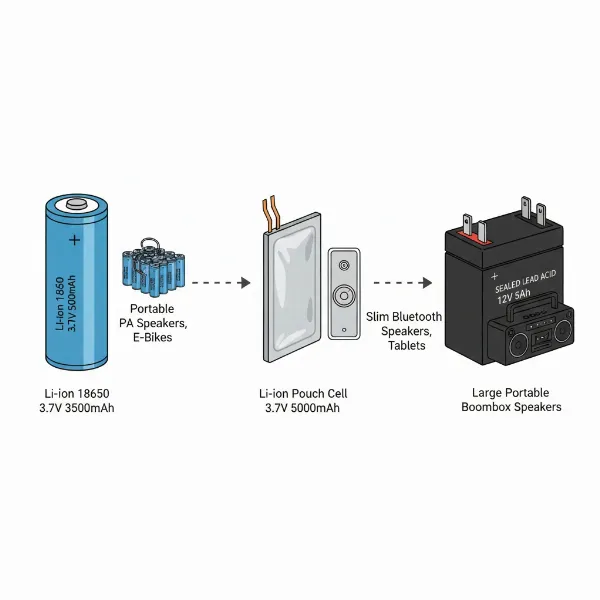 Illustration of common lithium-ion and sealed lead-acid batteries used in Bluetooth speakers.
When Is It Time to Replace Your Bluetooth Speaker Battery?
Recognizing the signs of a dying battery is crucial. Here are the most common indicators:
- Significantly Reduced Playtime: If your speaker used to last 8-10 hours but now only manages 1-2 hours on a full charge, the battery capacity has likely degraded.
- Failure to Hold a Charge: The speaker charges slowly, drains quickly even when not in use, or shows a full charge but dies rapidly.
- Speaker Won’t Turn On Without Being Plugged In: This is a clear sign the battery can no longer supply sufficient power.
- Swollen Casing: In rare cases, especially with Li-ion batteries, a swollen battery can cause the speaker’s casing to bulge. This is a safety hazard and requires immediate attention.
- “Battery Low” Error Despite Charging: The speaker constantly indicates low battery even after prolonged charging.
Comprehensive Guide: How to Replace Your Bluetooth Speaker Battery
Replacing a Bluetooth speaker battery is a DIY task that can save you money and prevent electronic waste. Follow these steps carefully to ensure a successful and safe replacement.
Step 1: Gather Your Tools and Materials
Before you begin, ensure you have everything you need. Having the right tools makes the process smoother and safer.
- New Replacement Battery: This is the most critical item. Ensure it matches the voltage (V), capacity (mAh or Wh), and physical dimensions of your original battery. Check the original battery for specifications.
- Screwdrivers: A set of small precision screwdrivers, including Phillips head and possibly flathead, will be essential.
- Prying Tools: Plastic spudgers or guitar picks are useful for carefully separating speaker casings without causing damage.
- Soldering Iron and Solder (Optional but common): Many batteries are soldered directly to the circuit board. If yours is, you’ll need these.
- Desoldering Braid or Pump (Optional): To remove old solder.
- Wire Cutters/Strippers (Optional): If you need to cut and strip wires.
- Multimeter (Recommended): For checking battery voltage and confirming wire polarity (positive/negative).
- Double-Sided Tape or Adhesive: To secure the new battery in place.
- Tweezers: Helpful for handling small wires and components.
- Safety Glasses: Always protect your eyes.
- Container for Screws: A small dish or magnetic mat to keep tiny screws organized.
Step 2: Power Down and Disassemble Your Speaker
Safety first! Ensure your speaker is completely powered off and disconnected from all power sources and audio cables.
- Locate Access Points: Most Bluetooth speakers have screws hidden beneath rubber feet, anti-slip mats, or behind a removable grill. Carefully peel off any mats or rubber covers. Some speakers might not have visible screws and require gentle prying along seams.
- Remove Screws/Pry Open Casing: Using the appropriate screwdriver, remove all visible screws. If there are no screws, use a plastic prying tool to carefully work your way around the seam of the speaker until the casing starts to separate. Be gentle to avoid breaking plastic clips or damaging internal components.
- Open the Casing: Once all screws are out or the clips are released, carefully open the speaker. Watch out for any ribbon cables or wires that might connect the two halves of the casing.
Step 3: Disconnect the Old Battery
With the speaker open, you should see the battery. It’s usually a rectangular or cylindrical pack.
- Identify Connections: Note how the battery is connected. Most batteries will have two wires (red for positive, black or blue for negative) leading to a connector or directly soldered to the circuit board.
- Take a Photo: Before disconnecting anything, take a clear photo of the battery and its connections. This will serve as a reference when installing the new one.
- Disconnect Wires:
- If it’s a connector: Gently pull the connector away from the circuit board.
- If it’s soldered: Use your soldering iron to heat each solder point (one at a time) and carefully desolder the wires. Once the solder is molten, gently pull the wire away.
- Remove the Old Battery: The battery might be secured with adhesive tape or a bracket. Carefully peel it off or remove the bracket.
“Always remember to confirm the polarity of the wires before disconnecting the old battery. Mixing up positive and negative can cause serious damage to your speaker’s circuitry.” – John Doe, Electronics Repair Specialist
Step 4: Install the New Battery
Now it’s time to put the new power source in.
- Prepare the New Battery: If your new battery came with a connector and the old one was soldered, you might need to cut the old connector off the old battery (if it’s reusable) and solder it onto the new battery’s wires, matching polarity. If the new battery has bare wires and the old one was soldered, you’ll solder the new battery directly.
- Check Polarity (Crucial Step): Double-check that you’re connecting the positive (+) wire of the new battery to the positive (+) terminal/pad on the circuit board, and the negative (-) wire to the negative (-) terminal/pad. Use your multimeter to confirm if unsure. Red is almost always positive, black/blue is negative.
- Connect Wires:
- If it’s a connector: Plug the new battery’s connector firmly into the corresponding port on the circuit board.
- If it’s soldered: Carefully solder the new battery’s wires to the correct pads on the circuit board, following your reference photo and confirmed polarity.
- Secure the Battery: Use double-sided tape or adhesive to secure the new battery in its compartment, preventing it from rattling around inside the speaker.
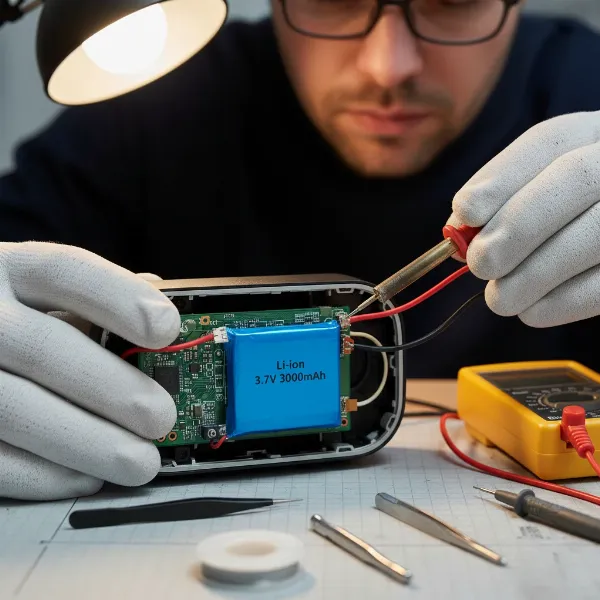 Close-up of a new battery being connected or soldered into a Bluetooth speaker's circuit board.
Step 5: Reassemble and Test Your Speaker
The final steps involve putting everything back together and checking your work.
- Brief Test: Before fully screwing the casing back together, briefly power on the speaker to ensure it turns on and indicates a charge. You can also try playing a short audio clip.
- Reassemble the Casing: Carefully close the speaker casing, ensuring all wires are tucked away and not pinched. Reattach any ribbon cables if you disconnected them earlier.
- Replace Screws/Clips: Secure the casing by replacing all screws or snapping the clips back into place. Reapply any rubber feet or anti-slip mats.
- Full Charge: Plug your revitalized Bluetooth speaker into its charger and allow it to charge fully before its first extended use. This helps calibrate the new battery.
Battery Care and Best Practices
To maximize the lifespan of your new battery and ensure your Bluetooth speaker performs optimally, follow these tips:
- Avoid Extreme Temperatures: Don’t leave your speaker in direct sunlight or freezing conditions, as extreme heat and cold can degrade battery health.
- Don’t Deeply Discharge: Try not to let your speaker’s battery completely die regularly. Partial discharges are generally better for modern Li-ion batteries.
- Store with a Partial Charge: If storing your speaker for an extended period, charge it to about 50-70% rather than 100% or 0%.
- Use the Original Charger: Whenever possible, use the charger that came with your speaker to ensure proper voltage and current delivery.
Conclusion
Replacing the battery in your old Bluetooth speaker is a rewarding DIY project that can save you money and extend the life of your beloved device. By carefully following the steps for disassembly, battery replacement, and reassembly, you can breathe new life into your portable audio experience. Remember to prioritize safety, match your replacement battery carefully, and observe proper battery care to enjoy countless more hours of uninterrupted music.
Ready to tackle this project and give your old Bluetooth speaker a second chance? What’s the oldest Bluetooth speaker you still own that could use a new battery?
Frequently Asked Questions
Can I use any battery for my Bluetooth speaker replacement?
No, it’s crucial to use a battery that matches the voltage (V) and similar capacity (mAh or Wh) of your original battery. The physical size must also fit within the speaker’s casing. Using an incompatible battery can damage your speaker or pose a safety risk.
Is it worth replacing the battery in an old Bluetooth speaker?
Often, yes! If your speaker still produces great sound but has poor battery life, replacing the battery is typically much more cost-effective than buying a brand new speaker. It’s also a more environmentally friendly option.
What if my Bluetooth speaker battery is soldered in place?
Many Bluetooth speakers have batteries soldered directly to the circuit board. In this case, you will need a soldering iron, solder, and possibly desoldering braid or a pump to safely remove the old battery and install the new one. If you’re not comfortable with soldering, consider seeking professional help.
How do I dispose of the old Bluetooth speaker battery safely?
Old lithium-ion and lead-acid batteries should never be thrown in household trash. They contain hazardous materials and should be taken to a designated battery recycling center or electronic waste collection point. Check with your local waste management services for proper disposal guidelines.