For gamers, the split-second timing of audio cues can be the difference between victory and defeat. Yet, the convenience of wireless Bluetooth headphones often comes with an unwelcome guest: audio latency. This delay, where sound lags behind the on-screen action, can shatter immersion and hinder performance. If you’ve ever felt that frustrating disconnect, you’re not alone. As an Admin with over a decade of hands-on experience in Bluetooth audio, I understand the intricacies of wireless sound. This comprehensive guide will equip you with the knowledge and practical steps to significantly reduce Bluetooth audio latency, ensuring your gaming experience is as seamless and responsive as it should be.
Understanding Bluetooth Audio Latency
Audio latency, in simple terms, is the time it takes for an audio signal to travel from its source (your gaming PC, console, or phone) to your headphones. While imperceptible in casual music listening or video playback (where visual synchronization can be adjusted), even a slight delay can be catastrophic in fast-paced gaming. Hearing a gunshot after you see the muzzle flash, or a crucial in-game voice line a moment too late, can disrupt gameplay and diminish your competitive edge.
The inherent nature of Bluetooth technology, which involves encoding, transmitting, and decoding audio wirelessly, introduces this delay. Various factors contribute to how pronounced this latency becomes, making some setups feel responsive and others almost unplayable.
Key Factors Influencing Latency in Bluetooth Audio
|
Our Picks for the Best Bluetooth speaker in 2026
As an Amazon Associate I earn from qualifying purchases.
|
||
| Num | Product | Action |
|---|---|---|
| 1 | Bluetooth Speaker with HD Sound, Portable Wireless, IPX5 Waterproof, Up to 20H Playtime, TWS Pairing, BT5.3, for Home/Party/Outdoor/Beach, Electronic Gadgets, Birthday Gift (Black) |

|
| 2 | Bluetooth Speaker with HD Sound, Portable Wireless, IPX5 Waterproof, Up to 20H Playtime, TWS Pairing, BT5.3, for Home/Party/Outdoor/Beach, Electronic Gadgets, Birthday Gift (Pink) |
|
| 3 | Bluetooth Speaker with HD Sound, Portable Wireless, IPX5 Waterproof, Up to 20H Playtime, TWS Pairing, BT5.3, for Home/Party/Outdoor/Beach, Electronic Gadgets, Birthday Gift (Teal) |
|
| 4 | Anker Soundcore 2 Portable Bluetooth Speaker with Stereo Sound, Bluetooth 5, Bassup, IPX7 Waterproof, 24-Hour Playtime, Wireless, Speaker for Home, Outdoors, Travel |
|
| 5 | Bluetooth Speaker with HD Sound, Portable Wireless, IPX5 Waterproof, Up to 20H Playtime, TWS Pairing, BT5.3, for Home/Party/Outdoor/Beach, Electronic Gadgets, Birthday Gift (Blue) |
|
| 6 | Anker Soundcore 2 Portable Bluetooth Speaker with Stereo Sound, Bluetooth 5, Bassup, IPX7 Waterproof, 24-Hour Playtime, Wireless, Speaker for Home, Outdoors, Travel- Navy Blue |
|
| 7 | Bluetooth Speaker with HD Sound, Portable Wireless, IPX5 Waterproof, Up to 20H Playtime, TWS Pairing, BT5.3, for Home/Party/Outdoor/Beach, Electronic Gadgets, Birthday Gift (Red) |
|
| 8 | Soundcore Anker 2 Portable Bluetooth Speaker with Stereo Sound, Bluetooth 5, Bassup, IPX7 Waterproof, 24-Hour Playtime, Wireless, Speaker for Home, Outdoors, Travel |
|
| 9 | Anker Soundcore 2 Portable Bluetooth Speaker with Stereo Sound, Bluetooth 5, Bassup, IPX7 Waterproof, 24-Hour Playtime, Wireless, Speaker for Home, Outdoors, Travel |
|
| 10 | Anker Soundcore 2 Portable Bluetooth Speaker with Stereo Sound, Bluetooth 5, Bassup, IPX7 Waterproof, 24-Hour Playtime, Wireless, Speaker for Home, Outdoors, Travel |
|
Several elements come into play when calculating the total audio latency you experience. Understanding these can help you pinpoint the weakest links in your setup.
Bluetooth Codecs
The codec is perhaps the most critical factor. It’s the algorithm used to compress and decompress audio data for wireless transmission. Different codecs offer varying balances of audio quality, efficiency, and—crucially for gamers—latency.
- SBC (Subband Codec): The mandatory baseline codec for all Bluetooth devices. It offers decent compatibility but often has higher latency, making it unsuitable for competitive gaming.
- AAC (Advanced Audio Coding): Common on Apple devices, AAC offers better sound quality than SBC but doesn’t necessarily reduce latency significantly for gaming, especially on non-Apple hardware.
- aptX: A family of codecs developed by Qualcomm.
- aptX HD/Adaptive: Focus on high-resolution audio, which can sometimes introduce more latency.
- aptX Low Latency (aptX LL): This is the gold standard for gaming over Bluetooth, specifically designed to minimize delay to around 30-40 milliseconds. Crucially, both your transmitting device and your headphones must support aptX LL to benefit from its low-latency performance.
- LDAC: Sony’s proprietary codec, prioritizing high-resolution audio over low latency, making it less ideal for gaming.
- LC3 (Low Complexity Communications Codec): Part of the new Bluetooth LE Audio standard, LC3 promises improved efficiency and potentially lower latency than SBC, though widespread adoption and specific gaming performance are still evolving.
Bluetooth Version and Hardware Quality
Newer Bluetooth versions (like Bluetooth 5.0 and above) offer improvements in data transfer speeds, stability, and energy efficiency, which can indirectly contribute to lower latency. However, the version alone isn’t a guarantee. The quality of the Bluetooth chip in both your source device and headphones, including their antenna design and processing power, also plays a significant role in how efficiently audio is handled.
Environmental Factors and Interference
Bluetooth operates on the 2.4GHz frequency band, which is shared by many other wireless devices, including Wi-Fi routers, microwaves, and other Bluetooth gadgets. This crowded spectrum can lead to signal interference, causing dropouts and increased latency. Physical obstacles like walls can also weaken the signal, forcing retransmissions that add delay.
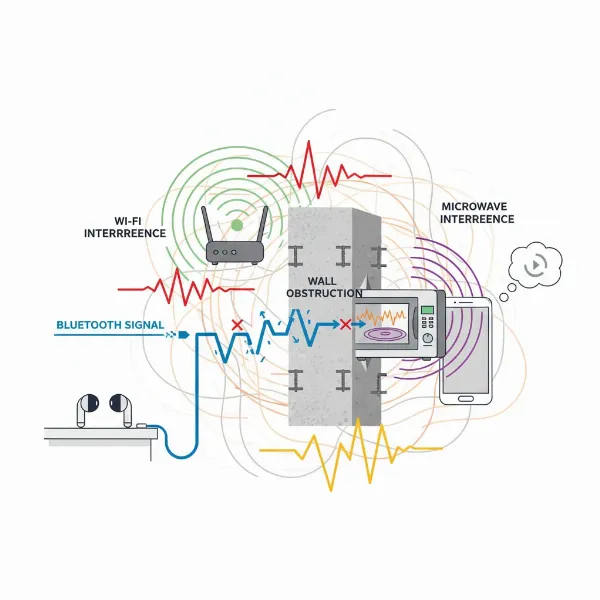 Bluetooth signal struggling with walls and other 2.4GHz devices, causing interference and latency.
The Impact of Latency on Gaming Performance
In single-player, story-driven games, a minor audio delay might be a mere annoyance. However, in competitive multiplayer titles like first-person shooters, fighting games, or rhythm games, latency is a critical disadvantage. It affects your ability to react to enemy footsteps, perfectly time a parry, or hit a note in sync with the music. Even non-competitive games lose their immersive quality when audio and visuals are out of sync.
Comprehensive Guide: Reducing Bluetooth Latency for Gaming
Tackling Bluetooth latency for gaming requires a multi-pronged approach, addressing both hardware and software aspects. Here’s how you can minimize the delay and enhance your gaming experience.
Assess Your Current Setup
Before diving into solutions, understand your existing hardware. Check your gaming headset’s specifications for supported Bluetooth codecs (e.g., aptX LL). Similarly, investigate your PC’s Bluetooth adapter or your phone’s capabilities. If either device lacks support for low-latency codecs, you might need hardware upgrades to see significant improvements.
Prioritize Low-Latency Codecs
This is often the most impactful step.
- Ensure aptX Low Latency Compatibility: If your headphones support aptX LL, make sure your transmitting device (PC, laptop, smartphone) also supports it. If your PC’s built-in Bluetooth doesn’t, consider a dedicated USB Bluetooth adapter that explicitly states aptX LL support.
- How to Check/Change Codecs:
- Android: Enable Developer Options (typically by tapping “Build number” seven times in “About phone”). Then, navigate to Developer Options, find “Bluetooth Audio Codec,” and select aptX LL if available.
- Windows: Windows often manages codecs automatically. If your headphones support aptX LL and your PC has a compatible adapter, it should default to it. Some third-party Bluetooth software might offer codec selection, but it’s less common than on Android. If you’re unsure, check your headphone manufacturer’s software or documentation.
- Note: If only one device supports a low-latency codec, they will default to a universally supported codec like SBC, negating the benefit.
Optimize Your Device Settings
Small tweaks in your device settings can often yield noticeable improvements.
- Update Drivers and Firmware: Outdated Bluetooth drivers on your PC or old firmware on your headphones can introduce unnecessary delays and bugs. Regularly check for and install updates for both. This ensures your devices are transmitting and receiving on the latest, most efficient versions of codecs.
- Disable Battery Saver/Power Saving Modes: On smartphones and laptops, battery saver modes can throttle performance, including Bluetooth transmission speeds, to conserve power. Disable these modes while gaming to allow your devices to operate at full capacity.
- Reduce Interference:
- Proximity: Keep your Bluetooth headphones as close as possible to the transmitting device. Even a few feet can make a difference.
- Line of Sight: Ensure a clear line of sight between your device and headphones, avoiding physical obstructions like walls or large furniture.
- Minimize Other Wireless Devices: Temporarily disable Wi-Fi on your gaming device (if using an Ethernet connection) or move other 2.4GHz devices further away during critical gaming sessions. Avoid pairing multiple Bluetooth devices to your source simultaneously.
- Disconnect and Re-pair: Sometimes, a simple reset can clear up temporary glitches. Unpair your headphones from your device, clear the Bluetooth cache (if applicable on Android), restart both devices, and then re-pair them.
- Clear Bluetooth Cache: On Android devices, clearing the Bluetooth cache in your app settings can resolve lingering connectivity issues that contribute to latency.
PC Specific Adjustments
Windows users have additional options to explore for reducing audio delay.
- Disable Audio Enhancements: Windows audio enhancements can introduce processing delays.
- Right-click the Speaker icon in your taskbar and select “Sound settings.”
- Click “More sound settings” (or “Sound Control Panel”).
- In the “Playback” tab, double-click your Bluetooth headphones.
- Go to the “Enhancements” tab and check “Disable all enhancements.” Click Apply.
- Check Windows Audio Service: Ensure the Windows Audio service is set to “Automatic” startup.
- Right-click the Start button and select “Run.”
- Type
services.mscand press Enter. - Find “Windows Audio” in the list, double-click it.
- Ensure “Startup type” is set to “Automatic.”
- Dedicated USB Bluetooth Adapter: If your PC has an older or generic Bluetooth module, investing in a high-quality USB Bluetooth adapter (especially one that explicitly supports aptX LL or Bluetooth 5.0/5.2 with enhanced data rates) can drastically improve performance.
Headphone Specific Tips
The headphones themselves play a crucial role in the latency equation. When purchasing new headphones for gaming, prioritize models that advertise low-latency features or explicitly state aptX LL support. Many gaming-specific wireless headsets opt for 2.4GHz wireless dongles (like Lightspeed or HyperSpeed) instead of standard Bluetooth for superior, near-zero latency performance. Low battery levels can sometimes cause Bluetooth devices to reduce their performance to conserve power, potentially increasing latency. Ensure your headphones are adequately charged before gaming.
 Gamer immersed in a game, wearing low-latency wireless headphones with crisp audio.
Comparison of Latency Reduction Methods
| Method/Factor | Impact on Latency | Pros | Cons |
|---|---|---|---|
| Low-Latency Codec (aptX LL) | High | Significant reduction in delay | Requires compatible hardware on both ends |
| Optimized Device Settings | Moderate | Often free, easy to implement | May not eliminate all latency |
| Reduce Environmental Interference | Moderate | Free, improves connection stability | Requires managing surroundings |
| Dedicated USB Adapter (PC) | Moderate | Upgrade older PC Bluetooth | Additional cost, occupies USB port |
| Wired Connection | Eliminates | Zero latency, highest reliability | Restricts movement |
| 2.4GHz Wireless | Near-zero | Excellent latency, wireless freedom | Requires proprietary USB dongle, not Bluetooth |
“While Bluetooth technology has come a long way in delivering quality wireless audio, for the critical demands of competitive gaming, understanding codecs and optimizing your setup are paramount to achieving a truly responsive experience.” – Alex Chen, Lead Audio Engineer at SoundSync Innovations
Recommended Hardware for Low-Latency Gaming
While this article focuses on Bluetooth, it’s essential to highlight that for the absolute lowest latency, dedicated gaming headsets often employ proprietary 2.4GHz wireless technology rather than standard Bluetooth. These systems use a USB dongle to create a direct, low-latency connection.
Dedicated Low-Latency Gaming Headsets
These headsets are engineered from the ground up for gaming. Look for models that boast:
- Proprietary 2.4GHz Wireless: Offers latency often below 20ms, rivaling wired connections. Examples include Logitech Lightspeed, Razer HyperSpeed, SteelSeries Quantum.
- aptX Low Latency Support: For situations where a dedicated dongle isn’t feasible, headphones with aptX LL provide the next best Bluetooth solution.
USB Bluetooth Adapters for PC
If your PC’s built-in Bluetooth module is outdated or doesn’t support aptX LL, a modern USB Bluetooth adapter can be a game-changer.
- Look for Bluetooth 5.0/5.2 or higher.
- Confirm aptX LL support in the product specifications. These adapters bypass your PC’s potentially inferior integrated Bluetooth.
Tips for Preventing Future Latency Issues
Maintaining a low-latency gaming environment is an ongoing effort. Adopt these habits to keep your audio crisp and synchronized.
Regularly Update Your Devices
Make it a routine to check for firmware updates for your headphones and driver updates for your PC’s Bluetooth adapter. Manufacturers frequently release updates that improve performance, stability, and even latency.
Maintain Optimal Charging Habits
Always ensure your wireless headphones are adequately charged. Performance dips and unexpected lag can often be attributed to critically low battery levels.
Invest in Compatible, Quality Hardware
When upgrading, always prioritize headphones and source devices that are known for their low-latency capabilities and codec support, especially aptX LL for Bluetooth. Reading reviews focused on gaming performance is highly recommended.
Conclusion
The quest for seamless gaming audio on Bluetooth is achievable with the right knowledge and tools. By understanding the role of codecs like aptX Low Latency, optimizing your device settings, minimizing interference, and making informed hardware choices, you can dramatically reduce the frustrating lag that plagues many wireless setups. While wired connections and dedicated 2.4GHz wireless solutions still offer the pinnacle of zero-latency performance, you don’t have to sacrifice wireless freedom entirely. Embrace these strategies, and you’ll find yourself fully immersed in the game, reacting to every sound cue with precision. What’s your favorite low-latency tip for fellow gamers?
Frequently Asked Questions
Why is Bluetooth audio always delayed for gaming?
Bluetooth audio involves encoding, transmitting, and decoding sound wirelessly, a process that inherently introduces a small delay, or latency. This delay is more noticeable in gaming because of the need for real-time audio-visual synchronization, where even slight desynchronization can affect gameplay. Inefficient codecs like SBC, signal interference, and hardware limitations are primary contributors to this delay.
What is the best Bluetooth codec for gaming to reduce latency?
The best Bluetooth codec for reducing latency in gaming is aptX Low Latency (aptX LL). It’s specifically designed to minimize audio delay to around 30-40 milliseconds, making it significantly more suitable for gaming than standard codecs like SBC or AAC. However, both your transmitting device and your headphones must support aptX LL to benefit from it.
Can I use regular Bluetooth headphones for gaming without lag?
While you can use regular Bluetooth headphones for gaming, you are more likely to experience noticeable lag, especially in fast-paced or competitive games. Most standard Bluetooth headphones use codecs like SBC or AAC, which have higher latency. For a truly lag-free experience, headphones supporting aptX Low Latency or dedicated 2.4GHz wireless gaming headsets are recommended.
How does Bluetooth version affect gaming latency?
Newer Bluetooth versions (e.g., Bluetooth 5.0, 5.2, LE Audio) offer improvements in data transfer rates, connection stability, and energy efficiency. While these improvements can indirectly help by providing a more robust connection and potentially allowing for more efficient codec usage, the Bluetooth version alone isn’t the primary determinant of latency. The codec being used remains the most critical factor.
Is a wired connection still better than Bluetooth for gaming?
Yes, for absolutely zero latency and the most reliable audio experience, a wired connection remains superior to Bluetooth for gaming. Wired connections bypass the wireless transmission and compression/decompression processes entirely, eliminating any potential for audio delay. Many competitive gamers still opt for wired headsets for this reason.
Can I reduce latency on my phone for mobile gaming?
Yes, you can reduce latency for mobile gaming on your phone. First, check if your phone and Bluetooth headphones support a low-latency codec like aptX Low Latency and enable it in developer options if available. Additionally, disable battery saver modes, keep your phone close to your headphones, minimize other wireless interference, and ensure your headphone firmware is updated.