Bringing your favorite audio to life from your TV or PC through a Bluetooth speaker can drastically improve your listening experience, whether you’re gaming, watching movies, or enjoying music. The good news is that connecting these devices is often a straightforward process, transforming your sound setup from standard to spectacular with just a few simple steps.
This comprehensive guide will walk you through the various methods of connecting your Bluetooth speaker to both a PC and a TV, including solutions for devices without built-in Bluetooth and essential troubleshooting tips to ensure a seamless audio journey.
Understanding Bluetooth Connectivity
Bluetooth technology offers a convenient wireless solution for transmitting audio, eliminating messy cables and providing flexibility in speaker placement. It creates a short-range wireless network between two devices, allowing them to communicate and share data, in this case, high-quality sound. Before diving into the connection process, it’s helpful to understand the basic principle: your speaker needs to be discoverable (in pairing mode), and your TV or PC needs to be able to scan for and connect to it.
Connecting Your Bluetooth Speaker to a PC
Connecting a Bluetooth speaker to your Windows PC can significantly enhance your desktop audio, whether for immersive gaming or crystal-clear music. The process is similar for both Windows 10 and Windows 11, with minor differences in menu navigation.
Prerequisites for PC Connection
|
Our Picks for the Best Bluetooth speaker in 2026
As an Amazon Associate I earn from qualifying purchases.
|
||
| Num | Product | Action |
|---|---|---|
| 1 | Bluetooth Speaker with HD Sound, Portable Wireless, IPX5 Waterproof, Up to 20H Playtime, TWS Pairing, BT5.3, for Home/Party/Outdoor/Beach, Electronic Gadgets, Birthday Gift (Teal) |

|
| 2 | Bluetooth Speaker with HD Sound, Portable Wireless, IPX5 Waterproof, Up to 20H Playtime, TWS Pairing, BT5.3, for Home/Party/Outdoor/Beach, Electronic Gadgets, Birthday Gift (Blue) |
|
| 3 | Soundcore Anker 2 Portable Bluetooth Speaker with Stereo Sound, Bluetooth 5, Bassup, IPX7 Waterproof, 24-Hour Playtime, Wireless, Speaker for Home, Outdoors, Travel |
|
| 4 | Anker Soundcore 2 Portable Bluetooth Speaker with Stereo Sound, Bluetooth 5, Bassup, IPX7 Waterproof, 24-Hour Playtime, Wireless, Speaker for Home, Outdoors, Travel- Navy Blue |
|
| 5 | Bluetooth Speaker with HD Sound, Portable Wireless, IPX5 Waterproof, Up to 20H Playtime, TWS Pairing, BT5.3, for Home/Party/Outdoor/Beach, Electronic Gadgets, Birthday Gift (Black) |
|
| 6 | Anker Soundcore 2 Portable Bluetooth Speaker with Stereo Sound, Bluetooth 5, Bassup, IPX7 Waterproof, 24-Hour Playtime, Wireless, Speaker for Home, Outdoors, Travel |
|
| 7 | Anker Soundcore 2 Portable Bluetooth Speaker with Stereo Sound, Bluetooth 5, Bassup, IPX7 Waterproof, 24-Hour Playtime, Wireless, Speaker for Home, Outdoors, Travel |
|
| 8 | Bluetooth Speaker with HD Sound, Portable Wireless, IPX5 Waterproof, Up to 20H Playtime, TWS Pairing, BT5.3, for Home/Party/Outdoor/Beach, Electronic Gadgets, Birthday Gift (Red) |
|
| 9 | Bluetooth Speaker with HD Sound, Portable Wireless, IPX5 Waterproof, Up to 20H Playtime, TWS Pairing, BT5.3, for Home/Party/Outdoor/Beach, Electronic Gadgets, Birthday Gift (Pink) |
|
| 10 | Anker Soundcore 2 Portable Bluetooth Speaker with Stereo Sound, Bluetooth 5, Bassup, IPX7 Waterproof, 24-Hour Playtime, Wireless, Speaker for Home, Outdoors, Travel |
|
First, ensure your PC has Bluetooth capabilities. Most modern laptops and many desktop computers come with built-in Bluetooth. If your desktop PC lacks this feature, you can easily add it using an inexpensive USB Bluetooth adapter.
Step-by-Step Guide for Windows 10 and Windows 11
- Enable Pairing Mode on Your Speaker: Turn on your Bluetooth speaker and activate its pairing mode. This usually involves pressing and holding a dedicated Bluetooth button or the power button until an indicator light flashes, signaling it’s ready to connect. Consult your speaker’s manual for specific instructions.
- Access Bluetooth Settings on Your PC:
- Windows 10: Click the Start button, then go to Settings > Devices > Bluetooth & other devices.
- Windows 11: Click the Start button, then go to Settings > Bluetooth & devices.
- Turn On Bluetooth: In the Bluetooth settings window, ensure the Bluetooth toggle switch is set to “On.” This makes your PC discoverable to other devices.
- Add Your Speaker: Click on “Add Bluetooth or other device” (Windows 10) or “Add device” (Windows 11). From the pop-up menu, select “Bluetooth.” Your PC will begin scanning for nearby Bluetooth devices.
- Select and Pair Your Speaker: When your Bluetooth speaker’s name appears in the list, click on it. Your PC will then attempt to pair with the speaker. Follow any on-screen prompts to confirm the connection.
- Set as Default Audio Output: Once connected, your PC typically sets the new speaker as the default audio output. If you don’t hear sound, click the speaker icon in your taskbar (usually bottom-right of the screen) and select your Bluetooth speaker from the list of playback devices.
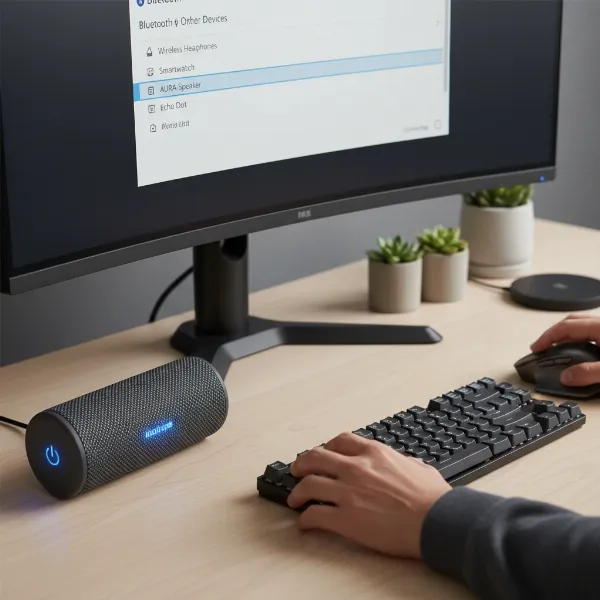 A person connecting a bluetooth speaker to a computer, with wireless waves illustrating the connection.
Connecting a PC without Built-in Bluetooth
If your PC doesn’t have native Bluetooth, a USB Bluetooth adapter is your solution. These small devices plug into a USB port and provide Bluetooth functionality. Once plugged in and any necessary drivers are installed (often automatically by Windows), you can follow the same steps above to pair your speaker.
Wired Alternatives for PC
For a direct and stable connection, an AUX cable remains a reliable option. If your PC and Bluetooth speaker both have 3.5mm auxiliary input/output ports, simply connect them with a compatible cable. This bypasses Bluetooth entirely, useful for older speakers or troubleshooting.
Connecting Your Bluetooth Speaker to a TV
Elevating your TV’s audio with a Bluetooth speaker can dramatically enhance your viewing experience, whether you’re watching movies, sports, or gaming. The method you use depends on whether your TV has built-in Bluetooth.
Smart TVs with Built-in Bluetooth
Most modern smart TVs from brands like Samsung, LG, Sony, and others are equipped with integrated Bluetooth, making wireless speaker connection seamless.
- Enable Pairing Mode on Your Speaker: Just like with your PC, turn on your Bluetooth speaker and set it to pairing mode. A flashing indicator light usually confirms it’s ready to connect.
- Access Bluetooth Settings on Your TV: Using your TV remote, navigate to the settings menu. Look for sections related to “Sound,” “Audio Output,” “Connections,” or “Bluetooth Audio Devices.” The exact path may vary slightly by TV brand and model.
- Scan for Devices: Within the Bluetooth settings, select an option like “Add New Device” or “Pair a Device.” Your TV will then search for available Bluetooth devices in its vicinity.
- Select and Connect Your Speaker: Once your Bluetooth speaker’s name appears on the TV screen, select it. The TV will pair with the speaker, and you’ll typically see a “Connected” message or hear a confirmation sound.
- Test Audio and Adjust Settings: Play some content on your TV to test the sound. If needed, go back into the TV’s audio settings to adjust the output, volume, or any audio sync options to match the picture.
Non-Smart TVs (or TVs without Bluetooth)
Don’t worry if your TV lacks built-in Bluetooth; you can still enjoy wireless audio. A Bluetooth audio transmitter is your go-to solution.
- Using a Bluetooth Audio Transmitter:
A Bluetooth transmitter is a small device that plugs into your TV’s audio output port and broadcasts the audio signal wirelessly to your Bluetooth speaker.- Connection Types:
- AUX (3.5mm headphone jack): Many TVs have a headphone jack. Plug one end of a 3.5mm audio cable into the TV’s headphone jack and the other into the transmitter’s input.
- RCA Audio Out (Red and White jacks): If your TV has RCA outputs, you’ll need an RCA to 3.5mm adapter cable to connect to the transmitter.
- Digital Optical (TOSLINK): For TVs with only an optical audio output, you’ll need a digital-to-analog audio converter (DAC) in addition to the transmitter. Connect an optical cable from your TV to the DAC, then an AUX cable from the DAC to the Bluetooth transmitter. Ensure your TV’s audio output is set to “PCM” format when using an optical connection.
- HDMI ARC to AUX Adapter: Some modern TVs might use HDMI ARC for audio output. An HDMI ARC to AUX adapter can convert this signal, allowing you to then connect it to a Bluetooth transmitter via an AUX cable.
- Transmitter Pairing: Once the transmitter is connected to your TV’s audio output and powered on, put your Bluetooth speaker into pairing mode. Then, follow the transmitter’s instructions to pair it with your speaker.
- Connection Types:
Wired Alternatives for TV
For a straightforward, non-Bluetooth connection, you can use a standard audio cable. If both your TV and speaker have 3.5mm AUX ports, a single AUX cable will work. For TVs with RCA audio outputs (red and white), you might use an RCA to 3.5mm cable to connect to your speaker’s AUX input.
Troubleshooting Common Bluetooth Connection Issues
Even with the clearest instructions, sometimes Bluetooth connections can be finicky. Here are solutions to common problems you might encounter:
- No Sound After Pairing:
- Check Audio Output Settings: On your PC, ensure your Bluetooth speaker is selected as the default playback device. On your TV, verify that the audio output is set to “Bluetooth” or “External Speaker.”
- Volume Levels: Confirm that both your speaker and the source device (TV/PC) have their volumes turned up and are not muted.
- Connection Drops or Interference:
- Proximity: Bluetooth works best over short distances. Keep your speaker relatively close to your TV or PC.
- Obstacles: Physical barriers like walls, furniture, or other electronic devices (especially those emitting radio frequencies like Wi-Fi routers or microwaves) can interfere with the signal. Try to minimize these.
- Other Devices: Disconnect any other Bluetooth devices that might be actively connected to your TV or PC to reduce signal interference.
- Audio Delay or Lip-Sync Issues:
- TV Audio Sync Settings: Many smart TVs offer an “Audio Delay” or “Lip Sync” adjustment in their sound settings. Experiment with these to synchronize the audio with the video.
- Speaker Firmware: Check your Bluetooth speaker’s manufacturer website or companion app for any available firmware updates, as these often include performance improvements and bug fixes for audio sync.
- Speaker Not Appearing in List or Failing to Pair:
- Restart Both Devices: A simple restart of both your Bluetooth speaker and your TV/PC can resolve temporary glitches.
- Verify Pairing Mode: Double-check that your speaker is correctly in pairing mode (indicator light flashing, specific sound/voice prompt).
- Forget and Re-pair: On your TV or PC, “forget” or “remove” the Bluetooth speaker from the list of paired devices. Then, restart both devices and attempt the pairing process from scratch.
- Toggle Bluetooth: Turn Bluetooth off on your TV/PC, wait a few seconds, then turn it back on. Do the same for your speaker.
- Update Drivers/Firmware: Ensure your PC’s Bluetooth drivers are up-to-date. For TVs and speakers, check for system software or firmware updates from the manufacturer.
- Bluetooth Capability: Confirm that your PC or TV actually has Bluetooth. If not, a USB Bluetooth adapter for your PC or a Bluetooth transmitter for your TV is necessary.
“Many Bluetooth connectivity issues can be resolved with a simple device restart or by ensuring no other paired devices are causing interference. Patience and systematic troubleshooting are key.”
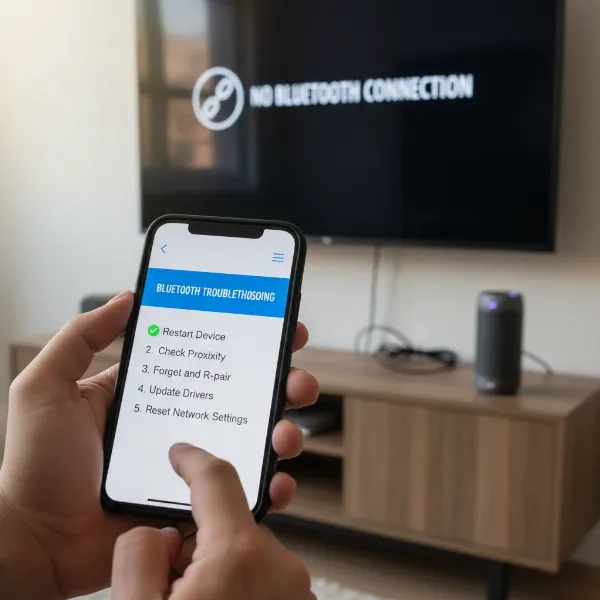 A person following troubleshooting steps to fix a bluetooth connection issue between a device and a speaker.
Expert Tip: Optimize for Best Performance
For the optimal audio experience, consider the placement of your Bluetooth speaker. Position it in an open area, ideally in front of your TV or PC, and avoid placing it in enclosed cabinets or corners, which can muffle sound or create unwanted echoes. Regularly updating the firmware of both your speaker and your TV/PC can also prevent compatibility issues and improve overall performance and sound quality.
Conclusion
Connecting your Bluetooth speaker to your TV or PC is an excellent way to enhance your audio experience, providing richer sound and greater flexibility. Whether your devices have built-in Bluetooth or require an adapter or transmitter, the steps are generally straightforward. By following these guides and understanding the common troubleshooting techniques, you can enjoy immersive sound for all your entertainment needs without the clutter of wires.
Ready to transform your home entertainment? Give these connection methods a try and rediscover your favorite content with enhanced audio quality!
Frequently Asked Questions
Can I connect multiple Bluetooth speakers to my TV or PC at once?
Some modern TVs and PCs support connecting multiple Bluetooth speakers simultaneously, often through specific brand features or dedicated apps. However, this is not a universal feature, and compatibility varies greatly.
Why is there a delay between my TV’s picture and the Bluetooth speaker’s audio?
Audio delay, also known as lip-sync issues, can occur due to processing time. Many smart TVs have an “Audio Sync” or “Lip Sync” adjustment in their sound settings to compensate. Ensuring both devices have the latest firmware can also help.
Do I need a special type of Bluetooth speaker to connect to my TV or PC?
No, most standard Bluetooth speakers are compatible. The main requirement is that both your speaker and your TV or PC support Bluetooth pairing. If your TV or PC doesn’t have built-in Bluetooth, you might need an external adapter or transmitter.
What’s the best way to connect a Bluetooth speaker to an older TV without Bluetooth?
For older TVs, the most effective solution is a Bluetooth audio transmitter. This device plugs into your TV’s audio output (like AUX, RCA, or optical) and broadcasts the sound wirelessly to your Bluetooth speaker, essentially adding Bluetooth functionality to your TV.