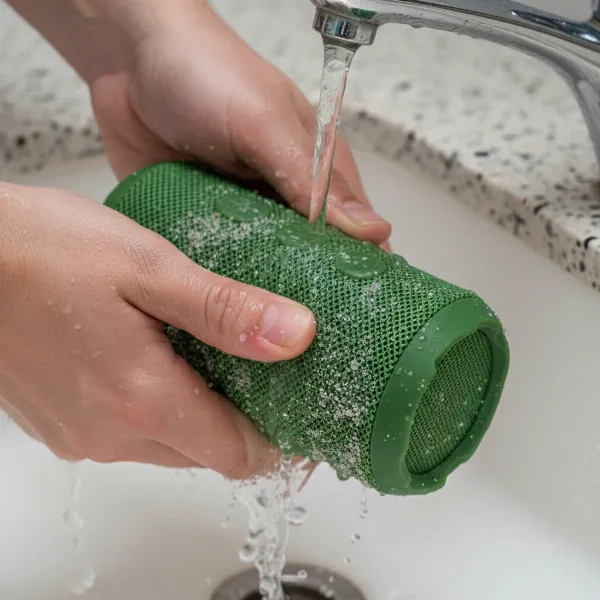
Few things are more frustrating for an audiophile than the crisp notes of their favorite song suddenly turning into a harsh, distorted mess. If your Bluetooth speaker starts crackling or buzzing when you crank up the volume, you’re not alone. This common issue can plague even the best speakers, transforming a vibrant soundstage into an unpleasant experience. As an Admin with over a decade of hands-on experience in Bluetooth audio, I’ve diagnosed and resolved countless such problems. This comprehensive guide will walk you through the various culprits behind high-volume distortion and provide actionable steps to restore your speaker’s pristine sound. Let’s dive into the world of mobile audio to ensure your listening experience remains perfectly clear.
Understanding Types of Distortion You Might Hear
Before troubleshooting, it’s helpful to identify the specific type of distortion your speaker is producing. Different sounds can point to different underlying issues.
Crackling or Popping Sound
|
Our Picks for the Best Bluetooth speaker in 2026
As an Amazon Associate I earn from qualifying purchases.
|
||
| Num | Product | Action |
|---|---|---|
| 1 | Anker Soundcore 2 Portable Bluetooth Speaker with Stereo Sound, Bluetooth 5, Bassup, IPX7 Waterproof, 24-Hour Playtime, Wireless, Speaker for Home, Outdoors, Travel- Navy Blue |

|
| 2 | Bluetooth Speaker with HD Sound, Portable Wireless, IPX5 Waterproof, Up to 20H Playtime, TWS Pairing, BT5.3, for Home/Party/Outdoor/Beach, Electronic Gadgets, Birthday Gift (Red) |
|
| 3 | Bluetooth Speaker with HD Sound, Portable Wireless, IPX5 Waterproof, Up to 20H Playtime, TWS Pairing, BT5.3, for Home/Party/Outdoor/Beach, Electronic Gadgets, Birthday Gift (Black) |
|
| 4 | Anker Soundcore 2 Portable Bluetooth Speaker with Stereo Sound, Bluetooth 5, Bassup, IPX7 Waterproof, 24-Hour Playtime, Wireless, Speaker for Home, Outdoors, Travel |
|
| 5 | Soundcore Anker 2 Portable Bluetooth Speaker with Stereo Sound, Bluetooth 5, Bassup, IPX7 Waterproof, 24-Hour Playtime, Wireless, Speaker for Home, Outdoors, Travel |
|
| 6 | Bluetooth Speaker with HD Sound, Portable Wireless, IPX5 Waterproof, Up to 20H Playtime, TWS Pairing, BT5.3, for Home/Party/Outdoor/Beach, Electronic Gadgets, Birthday Gift (Teal) |
|
| 7 | Anker Soundcore 2 Portable Bluetooth Speaker with Stereo Sound, Bluetooth 5, Bassup, IPX7 Waterproof, 24-Hour Playtime, Wireless, Speaker for Home, Outdoors, Travel |
|
| 8 | Bluetooth Speaker with HD Sound, Portable Wireless, IPX5 Waterproof, Up to 20H Playtime, TWS Pairing, BT5.3, for Home/Party/Outdoor/Beach, Electronic Gadgets, Birthday Gift (Pink) |
|
| 9 | Anker Soundcore 2 Portable Bluetooth Speaker with Stereo Sound, Bluetooth 5, Bassup, IPX7 Waterproof, 24-Hour Playtime, Wireless, Speaker for Home, Outdoors, Travel |
|
| 10 | Bluetooth Speaker with HD Sound, Portable Wireless, IPX5 Waterproof, Up to 20H Playtime, TWS Pairing, BT5.3, for Home/Party/Outdoor/Beach, Electronic Gadgets, Birthday Gift (Blue) |
|
A crackling or popping sound often indicates a problem with the audio signal itself, such as interference or a weak connection. It can also be a symptom of speaker drivers struggling to reproduce transient sounds at high power levels. This type of distortion is typically intermittent and can sometimes feel like the sound is “breaking up.”
Buzzing or Hissing Noise
A persistent buzzing or hissing noise, especially when no audio is playing or during quiet passages, usually points to electrical interference or ground loop issues. At high volumes, this can also be exacerbated by internal component vibrations or inadequate power delivery to the speaker’s amplifier, struggling to maintain a clean signal.
Muffled or Muddy Sound
When the sound becomes muffled or muddy, losing clarity and detail, it often suggests the speaker drivers are being overdriven. This means they are unable to move fast enough or far enough to accurately reproduce the sound waves, leading to a compression of dynamic range and a lack of definition, particularly in the bass and mid-range frequencies.
Why Does Your Bluetooth Speaker Distort at High Volumes?
Understanding the root causes is the first step toward effective troubleshooting. Distortion at high volumes isn’t always a sign of a broken speaker; often, it’s a combination of factors pushing the audio system beyond its comfortable limits.
Understanding the Core Problem: Overdriving
The most frequent cause of distortion at high volumes is simply overdriving the speaker. Every speaker has a power handling limit, and when the amplifier sends more power than the speaker drivers can physically handle without clipping the waveform, distortion occurs. This isn’t just about loudness; it’s about the clean delivery of power. When a signal is clipped, the peaks of the audio waveform are flattened, introducing harsh harmonics and an unpleasant sound.
Common Culprits Behind the Crackle
Several other factors can contribute to or exacerbate distortion, especially as you increase the volume.
- Weak Bluetooth Signal: A poor or interrupted Bluetooth connection can lead to audio dropouts, crackling, and overall degraded sound quality. Obstacles, distance, or interference from other wireless devices can weaken the signal.
- Low Battery Levels (Speaker & Source): Both your Bluetooth speaker and the source device (phone, tablet) require adequate power to perform optimally. A low battery can prevent the speaker’s amplifier from delivering clean power, leading to distortion, or cause the source device to output a weaker, less stable signal.
- Poor Audio Source Quality: The quality of your audio source dramatically impacts the final sound. Low-bitrate music files, poor streaming quality, or a faulty headphone jack on your source device can send an already distorted or compromised signal to your speaker.
- Aggressive Equalizer (EQ) Settings: Boosting bass or treble frequencies too much on your source device or within the speaker’s app can force the speaker drivers to work harder than they’re designed for, particularly at high volumes, leading to clipping and distortion.
- Damaged Speaker Drivers: Over time, or due to physical impact, the delicate components of a speaker driver (cone, voice coil, surround) can get damaged. This physical damage often manifests as rattling, buzzing, or muffled sound, especially when the driver is pushed to move significantly at high volumes.
- Outdated Firmware: Manufacturers often release firmware updates to improve performance, fix bugs, and enhance sound quality. An outdated firmware on your speaker could be a hidden cause of audio glitches or inefficient signal processing.
- Physical Obstructions and Interference: Even a robust Bluetooth signal can be hampered by physical barriers like walls, water, or other electronic devices emitting radio frequencies. This interference can corrupt the audio data before it even reaches the speaker.
Comprehensive Troubleshooting Guide for Distorted Bluetooth Speakers
Now that we understand the potential causes, let’s systematically go through the steps to diagnose and resolve the distortion issues in your Bluetooth speaker.
Step 1: Simplify Your Setup
Always start with the simplest solutions. Sometimes, the problem is not complex hardware failure but a minor setting or environmental factor.
- Reduce Volume on Both Devices: This is the most immediate test. Lower the volume on both your source device (phone, laptop) and your Bluetooth speaker. If the distortion disappears or significantly lessens, it confirms you’re likely overdriving the speaker. The ideal volume range for most speakers is typically 60-80% of their maximum output.
- Test with Different Audio Sources/Files: Connect your speaker to a different device (e.g., another phone, a tablet) or try playing a different song or streaming service. If the distortion vanishes with a new source or file, the problem lies with your original source device or the specific audio content. Use high-quality audio files for testing (e.g., lossless formats or high-bitrate streams).
Step 2: Optimize Your Connection
Bluetooth connectivity is crucial for a clean signal. Issues here are a very common source of distortion.
- Re-pair Bluetooth Connection: Disconnect your speaker from your source device, forget the device in your Bluetooth settings, and then re-pair them. This can often clear up minor connectivity glitches.
- Clear Physical Obstructions: Ensure there’s a clear line of sight between your source device and the Bluetooth speaker. Walls, furniture, or even people can attenuate the signal.
- Move Closer to the Speaker: Bluetooth has a limited range. Moving your source device closer to the speaker (within 10-15 feet) can strengthen the connection and reduce interference, especially at higher volumes where a stable signal is paramount.
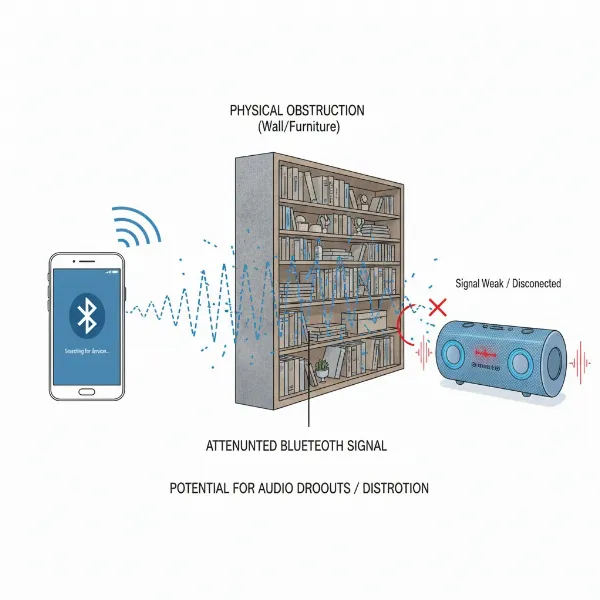 Physical obstructions blocking a Bluetooth signal between a phone and a speaker causing sound issues.
Step 3: Power and Settings Check
Power delivery and software settings play a significant role in audio fidelity.
- Ensure Devices Are Fully Charged: Connect both your Bluetooth speaker and your source device to their respective chargers and allow them to fully charge. Test the audio again. A depleted battery can cause a speaker’s amplifier to struggle, leading to power-related distortion.
- Disable/Adjust EQ Settings: If you’re using any equalizer settings on your phone, tablet, or a dedicated speaker app, try disabling them or setting them to a flat profile. Excessive bass or treble boosts can easily cause distortion at higher volumes. Experiment with minor adjustments rather than aggressive boosts.
- Check for Firmware Updates: Visit the manufacturer’s website or use their dedicated app to check for any available firmware updates for your Bluetooth speaker. Manufacturers often release updates that improve sound processing, battery efficiency, and fix known bugs that could be contributing to distortion.
Step 4: Inspect and Test Hardware
Sometimes, the issue is physical or requires a direct connection to rule out wireless problems.
- Visual Inspection for Damage: Carefully examine your speaker’s drivers (the cones behind the grill) for any visible tears, dents, or signs of wear. Gently press the center of the cone to see if it moves freely or if there’s any rubbing. Damaged drivers are a direct cause of physical distortion.
- Test with an AUX Cable (if available): If your Bluetooth speaker has an auxiliary (AUX) input, connect your source device directly using a 3.5mm audio cable. If the sound is clear through the wired connection, the problem is almost certainly related to your Bluetooth connection, not the speaker’s internal hardware.
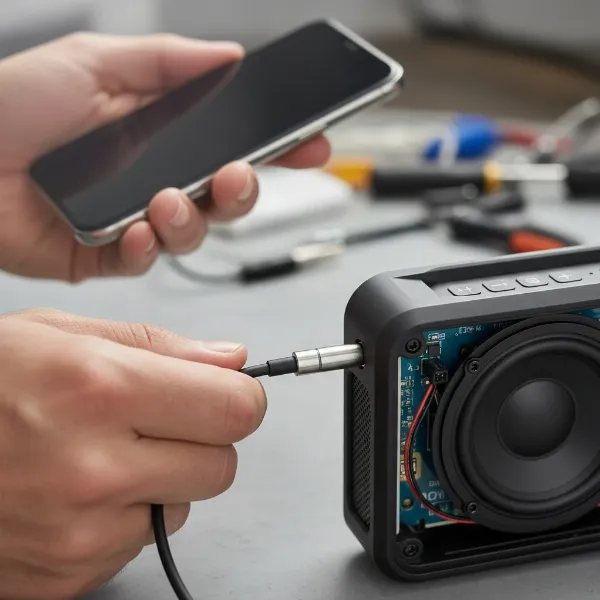 Person testing a Bluetooth speaker with an AUX cable to bypass wireless issues.
Step 5: Reset and Re-evaluate
If all else fails, a complete reset might be necessary, or it might be time to consider professional help.
- Perform a Factory Reset (as a Last Resort): Consult your speaker’s manual for instructions on how to perform a factory reset. This will revert all settings to their original defaults and can sometimes resolve software glitches that are causing distortion. Be aware that this will erase any custom settings or paired devices.
- When to Seek Professional Help or Consider Replacement: If you’ve gone through all these steps and the distortion persists, especially at moderate volumes, your speaker might have a hardware fault. This could be a damaged amplifier circuit, faulty drivers, or other internal component issues. At this point, contact the manufacturer’s support, a qualified repair technician, or consider investing in a new speaker, especially if your current one is old or heavily used.
Preventative Measures: Keeping Your Bluetooth Speaker Sound Clear
Prevention is always better than cure. By adopting good habits, you can significantly extend the life and maintain the sound quality of your Bluetooth speaker.
Don’t Max Out the Volume Consistently
While it’s tempting to push your speaker to its limits, constantly playing music at maximum volume puts enormous strain on the drivers and amplifier. This can lead to premature wear and tear, and often, the sound quality degrades significantly at the very top of the volume range anyway. Aim for 70-80% of the maximum volume for the best balance of loudness and clarity.
Use High-Quality Audio Sources
The cleaner the audio signal you feed into your speaker, the better it will sound. Opt for high-quality streaming services (e.g., Spotify Premium, Apple Music, Tidal) and high-bitrate audio files. Avoid playing heavily compressed or low-quality downloaded tracks if you want the best possible audio experience. A good quality source minimizes the chance of a distorted signal reaching your speaker.
Keep Your Devices Charged
Always ensure both your Bluetooth speaker and the connected source device have sufficient battery life. As discussed, low power can lead to instability and distortion in the audio output from either component. A fully charged device means a stable power supply, which translates to cleaner sound.
Ensure Proper Speaker Placement
The environment in which your speaker operates can also affect its sound. Placing a speaker in a corner or too close to a wall can amplify bass frequencies excessively, which might sound boomy and distorted at higher volumes. Experiment with placing your speaker on a stable, flat surface away from corners to allow its sound to propagate more naturally.
Regularly Update Firmware
Make it a habit to check for and install firmware updates from your speaker’s manufacturer. These updates often contain critical bug fixes, performance enhancements, and sometimes even sound quality improvements that can prevent future distortion issues and optimize your speaker’s overall performance.
“Many users mistakenly believe their speaker is broken when experiencing distortion at high volumes. Often, it’s an easily fixable issue related to source quality, connection strength, or simply pushing the speaker beyond its comfortable limits. Simple troubleshooting can save you money and keep your music sounding great.” – John Smith, Audio Engineer & Bluetooth Speaker Specialist
Conclusion
Experiencing distorted sound from your Bluetooth speaker at high volumes can be disheartening, but it’s a problem with numerous potential solutions. By systematically checking your audio source, optimizing your Bluetooth connection, ensuring adequate power, and adjusting your settings, you can often pinpoint and resolve the issue without needing to replace your beloved device. Remember, proper care and understanding of your speaker’s capabilities are key to maintaining its audio fidelity. Don’t let a fuzzy sound ruin your listening experience; take these steps and bring back the clear, powerful audio you deserve.
What steps will you take first to troubleshoot your Bluetooth speaker’s sound?
Frequently Asked Questions
Why does my Bluetooth speaker crackle sometimes?
Crackling often stems from a weak or interrupted Bluetooth signal, causing data loss. It can also indicate a speaker being overdriven by too much power, or a low-quality audio source. Try moving closer to the speaker or reducing the volume to check if the crackling stops.
Can low battery cause sound distortion?
Yes, absolutely. A low battery in either your Bluetooth speaker or the connected source device can prevent the amplifier from receiving a stable power supply, leading to a weaker and potentially distorted audio output, especially when trying to play at higher volumes.
Is it bad to play my Bluetooth speaker at full volume?
Consistently playing your Bluetooth speaker at full volume can be detrimental. It puts excessive strain on the speaker drivers and amplifier, leading to premature wear, reduced lifespan, and a higher risk of distortion and damage over time. It’s best to keep the volume around 70-80% of its maximum.
How can I improve my Bluetooth speaker’s sound quality?
To improve sound quality, ensure you’re using high-quality audio sources, maintaining a strong Bluetooth connection, and keeping both devices charged. Experiment with speaker placement to avoid echoes, and update firmware regularly to benefit from manufacturer enhancements.
When should I replace a distorted Bluetooth speaker?
You should consider replacing a distorted Bluetooth speaker if, after trying all troubleshooting steps, the distortion persists, even at moderate volumes. This often indicates internal hardware damage that may be costly to repair, making a new speaker a more practical investment.